Cart
0
Most people buy a flashlight the same way: they sort by lumens, pick the biggest number, and call it done. Then they end up with a blinding spotlight they can't aim in a tight space, or a pocket light that dies after twenty minutes of real work. The problem isn't the brightness — it's the mismatch between tool and task.
Flashlights are actually a category with real, meaningful differences between types. Once you understand those differences, the right pick becomes obvious. Here's how four distinct types break down — and which situations each one was actually built for.
The Right-Angle Work Light: Your Hands-Free Problem Solver
If you've ever tried to hold a standard flashlight in your mouth while fixing something under a sink or inside a panel box, you already understand why right-angle lights exist. The head sits perpendicular to the body, which means you can clip it to a belt loop, a pocket, or a strap and have it pointing exactly where you're working — without occupying either hand.
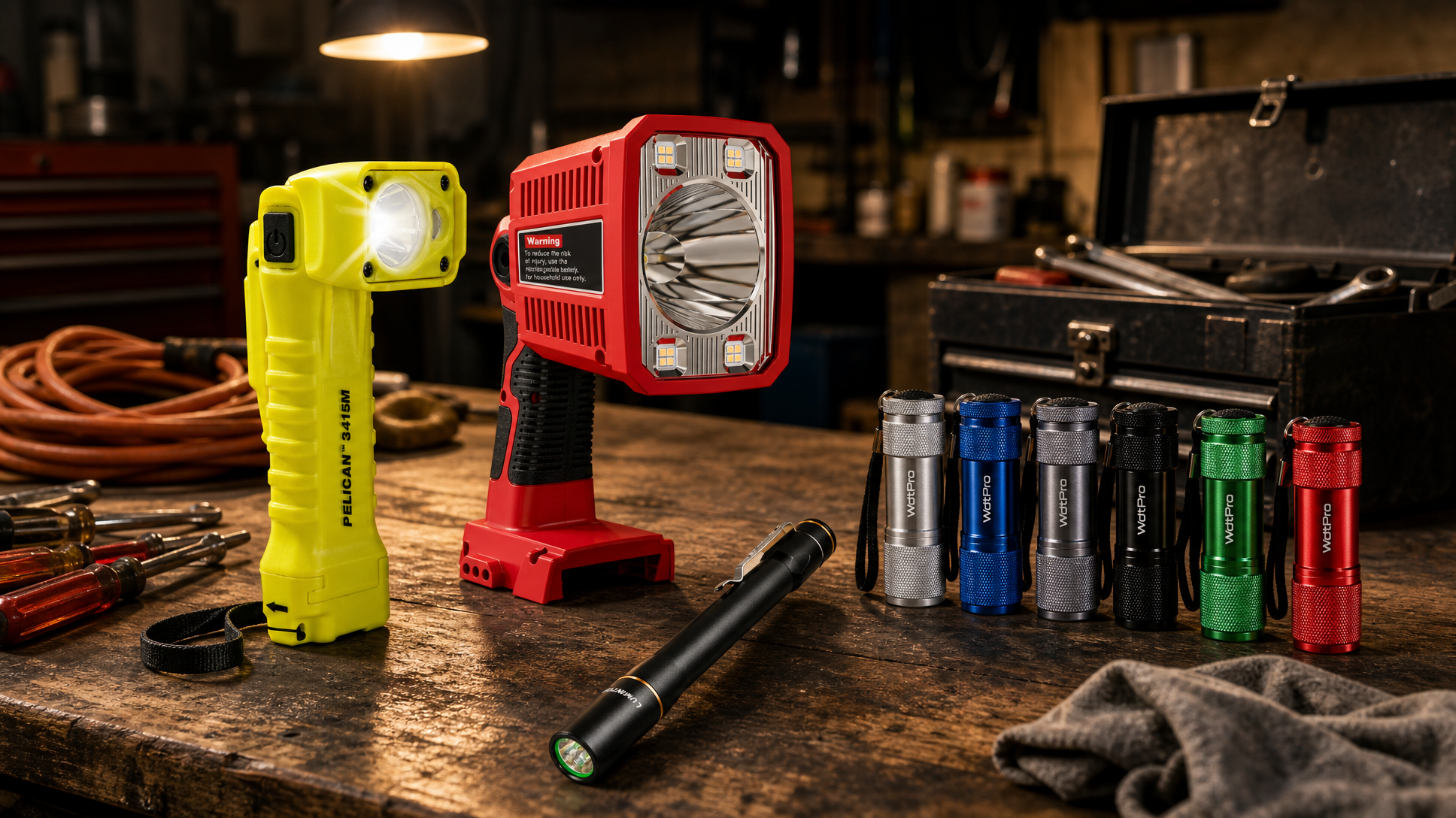
The Pelican 3415 Right Angle LED Flashlight is the clearest example of this form factor done right. It's built from ABS material in a bright yellow body that's easy to spot in a gear bag or on a dark floor, with a magnetic clip that lets you stick it to a metal surface and walk away — the light stays put and keeps shining. That right-angle head isn't a gimmick; it's the entire point of the design.
This type suits: electricians, mechanics, first responders, and anyone doing hands-on work in confined or low-light spaces. It's also a strong emergency kit choice precisely because it can stand on its own (literally) while you deal with a situation.
The High-Output Spotlight: When You Need to Light Up a Distance
There's a category of flashlight that's less about portability and more about raw, directed output — the kind of light that reaches across a parking lot, illuminates a job site perimeter, or cuts through rain and fog. These are spotlight-style work lights, and they're built around a large reflector and a powerful LED array.
The DTEZTECH 18W Flashlight for Milwaukee M18 Battery sits squarely in this camp. It's a red and black spotlight-style work light with a large reflective head housing both a central LED and four corner LED clusters, a rubberized grip handle, and a built-in stand at the base so it can sit upright on a flat surface. The pivoting head — rated to 110° — means you can angle the beam without repositioning the whole unit. It draws power from Milwaukee M18 batteries, which is a practical advantage if you're already in that tool ecosystem and have charged packs on hand. There's also a USB port for charging other devices, which makes it genuinely useful during a power outage.
This type suits: contractors, outdoor workers, campers who need area lighting, and homeowners who want a serious emergency light that doubles as a job site tool.
The Penlight: Precision in a Pocket
A penlight does one thing that no other flashlight form factor does as well: it fits in a shirt pocket, clips there securely, and produces a focused beam narrow enough to read a label, inspect a wire, or check a patient's eyes. It's not the tool for lighting a room. It's the tool for seeing exactly one small thing clearly.
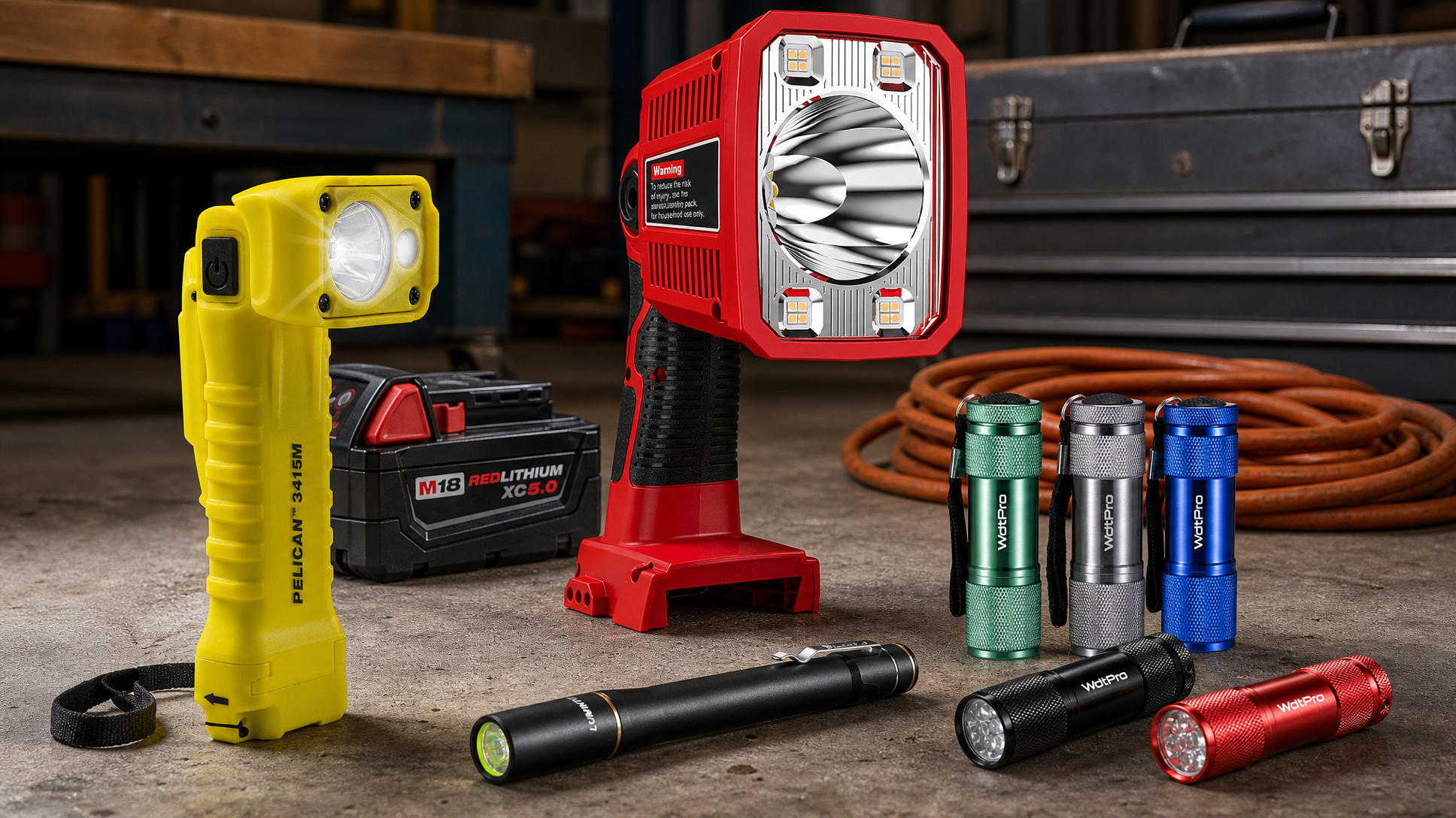
The LUMINTOP IYP365 Penlight is a slim, matte black aluminum tube — pen-sized, with a stainless pocket clip and a green-ringed LED at the tip. It's IPX-8 water resistant, runs on two AAA batteries, offers three output modes, and puts out up to 200 lumens. For a light this size, that's genuinely useful output. The aluminum body means it won't flex or crack in a pocket, and the clip keeps it oriented correctly so you're not fishing around for it in the dark.
This type suits: medical and dental professionals, technicians, inspectors, and anyone who needs a reliable light that lives in a pocket and doesn't get in the way. It's also a smart addition to a car glove box or a first aid kit — small enough to forget it's there until you actually need it.
The Mini Multi-Pack: Coverage Over Performance
Here's the honest truth about single high-performance flashlights: they tend to live in one place. The garage. The junk drawer. The emergency kit. Which means the moment you need a light somewhere else — the car, the kid's backpack, the camping bin, the nightstand — you're out of luck.
That's the problem the WdtPro LED Mini Flashlights 6-Pack solves. Six compact aluminum torches in assorted colors (silver, blue, gray, black, green, and red), each with a wrist strap and a 9-LED head. They're not going to replace a dedicated work light, and they're not trying to. What they do is give you a light everywhere you might need one, without having to think about it. Assign one to each car, toss one in each emergency kit, give one to each kid — done.
The assorted colors are more useful than they sound: color-coding by location or person means you're not hunting for "the flashlight," you're grabbing the blue one from the car or the green one from the camping bin. Batteries are included, so there's no delay between unboxing and having working lights in every corner of your life.
This type suits: families, renters building a basic emergency kit, campers who want a light per tent, and anyone who's ever been frustrated that the one flashlight in the house is never where they need it.
So Which One Do You Actually Need?
The honest answer is probably more than one — but the starting point is matching the form factor to the situation, not chasing the highest lumen count.
- Working with your hands in a tight space? A right-angle light like the Pelican 3415 keeps the beam where you're looking without tying up your hands.
- Need to light up a large area or reach across a distance? A spotlight-style work light like the DTEZTECH gives you output and flexibility that a handheld tube light can't match.
- Need precision in a pocket? A penlight like the LUMINTOP IYP365 is the only form factor that genuinely lives in a shirt pocket and stays ready.
- Need coverage across multiple locations? A multi-pack like the WdtPro 6-Pack is the most practical answer — one per car, one per kit, one per room.
Stop buying the brightest listing and start buying the right shape for the job. That's the whole game.
Ready to find the right fit? Browse flashlights and emergency lights at LightsDaddy — from compact penlights to heavy-duty work lights, there's a type for every situation and budget.
Frequently Asked Questions
What's the difference between lumens and beam distance — which matters more?
Lumens measure total light output; beam distance measures how far the light reaches usefully. For close-up work (under a hood, inside a cabinet), high lumens matter more than beam distance. For spotting things far away — across a yard or a job site — beam distance becomes the priority. Most listings show both, so check both numbers rather than just the lumens figure.
Are right-angle flashlights only useful for tradespeople, or do they make sense for home use?
They're genuinely useful for anyone doing hands-on tasks — assembling furniture, doing plumbing repairs, working in a dark attic or crawl space. The clip and right-angle head free up both hands, which is just as valuable at home as it is on a job site. They also work well as emergency lights because many models can stand upright or clip to something while you deal with a situation.
What does IPX-8 water resistance actually mean for a flashlight?
IPX-8 is one of the higher water resistance ratings — it means the light has been tested for continuous submersion beyond one meter. In practical terms, it can handle rain, splashes, being dropped in a puddle, and similar real-world exposure without failing. It's a meaningful spec for a penlight that lives in a pocket or a kit, where exposure to moisture is a real possibility.
Is a flashlight multi-pack worth it, or is it better to buy one good light?
Both, honestly — they solve different problems. A single high-quality light (right-angle, spotlight, or penlight) is the right call when you have a specific, demanding use case. A multi-pack is the right call when your problem is coverage: you need a working light in the car, the emergency kit, the camping bag, and the nightstand all at once. Most households benefit from having at least one of each.