Cart
0

You measured once, ordered with confidence, and then the package arrived. The crystals are the right shape, the right attachment type — and somehow they look completely wrong hanging next to the originals. Too small, too thick, or just slightly off in a way that's hard to articulate but impossible to unsee.
This is the most common chandelier crystal mistake, and it's almost never about picking the wrong attachment. It's about size — specifically, misreading what the size listed in a product description actually refers to.
Why Listing Photos Lie to You
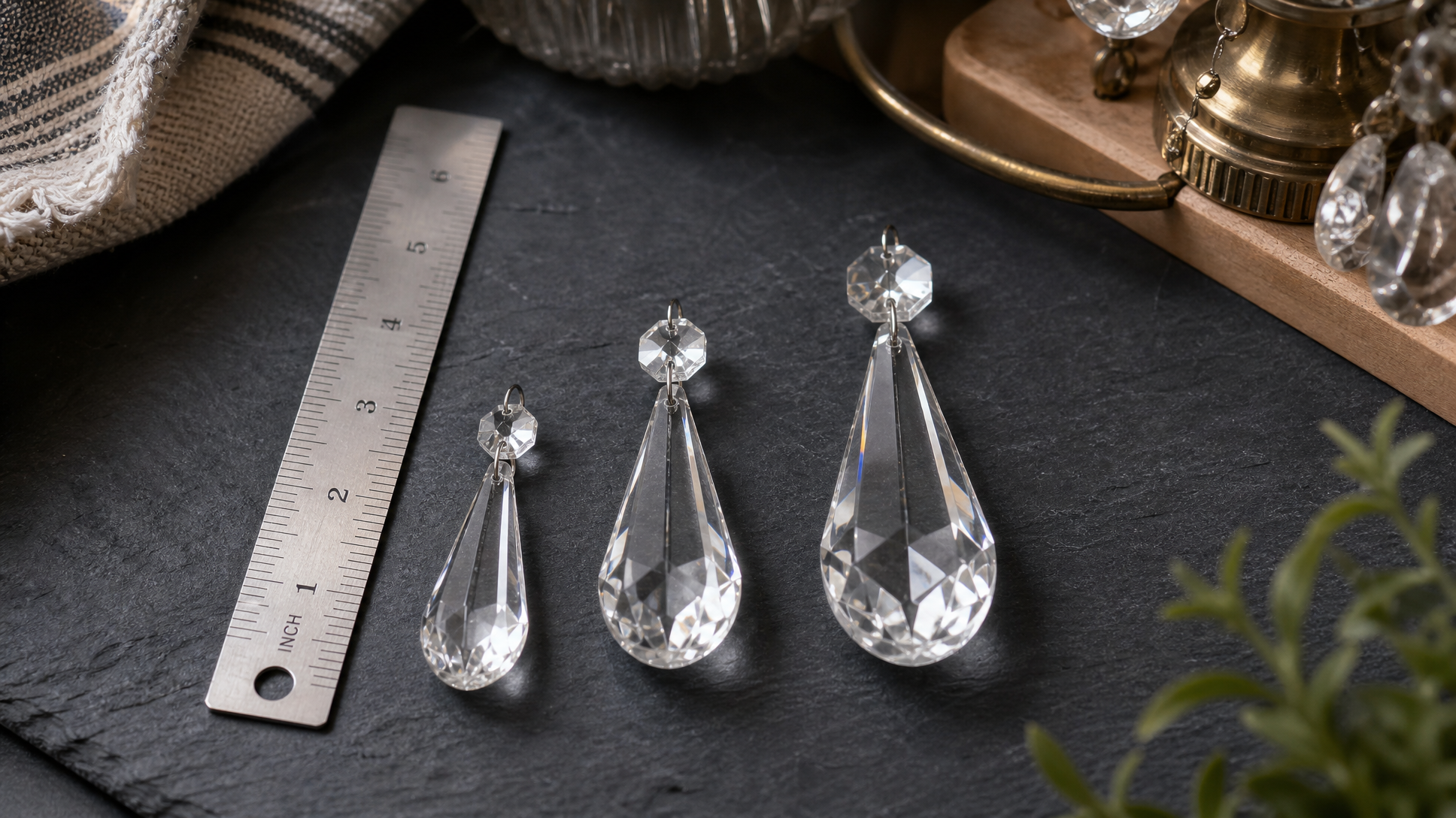
Crystal product photos are almost always shot in isolation, usually against a white background, with no reference object in frame. A teardrop crystal that's 38mm long and one that's 50mm long can look identical in a listing photo. The difference only becomes obvious when they're hanging next to your existing pieces.
Even listings that include a ruler in the photo can mislead you, because the angle of the shot can compress or stretch the apparent length. The only reliable source of information is the listed dimensions — and knowing exactly what those dimensions are measuring.
What the Listed Dimensions Actually Mean
This is where most people go wrong. Crystal dimensions are typically listed as a single number (like "38mm" or "2 inch"), and it's rarely obvious whether that measurement refers to the total hanging length including the pin or loop, the crystal body only, or the longest diagonal of the piece.
Here's the general breakdown for common crystal shapes:
- Teardrop / pendeloque crystals: The listed length usually refers to the crystal body only, not the metal pin or wire loop at the top. Add roughly 5–10mm for the hardware when estimating total hanging length — but verify this with the seller if the listing doesn't specify.
- Octagon / bead crystals: The single measurement is typically the diameter across the widest flat face. Two octagon crystals listed at the same size from different manufacturers can still differ in thickness, which affects how they catch light.
- Icicle / prism crystals: Often listed by total length including the top loop, but not always. If the listing photo shows the loop clearly, assume it's included; if it doesn't, ask.
- Flat diamond / almond shapes: Usually listed by the longest dimension (top to bottom point), not the width. A 50mm almond crystal is 50mm tall, not 50mm wide.
If a listing gives two dimensions (e.g., "38mm x 25mm"), the first is almost always the length and the second is the width at the widest point. When in doubt, contact the seller before ordering — a quick message asking "does the 38mm measurement include the top pin?" takes thirty seconds and saves a return.
How to Measure Your Existing Crystals Correctly
Take one of your existing crystals off the chandelier before you order anything. Measure it three ways:
- Total hanging length: From the very top of the pin or loop to the lowest point of the crystal. This is what determines how the crystal looks on the fixture — its visual presence in the cluster.
- Crystal body only: From where the pin meets the crystal to the bottom tip. This is usually what the listing refers to, so this is your matching number.
- Widest point: For shaped crystals (octagons, almonds, teardrops), measure the widest cross-section. Two crystals with the same body length but different widths will look mismatched in a cluster.
Write all three measurements down. When you're looking at a listing, match your "crystal body only" measurement to the listed dimension, then verify the total hanging length makes sense by adding estimated hardware.
The "Same Style" Problem
Here's a subtler issue: crystals described as the same style — say, "classic teardrop" or "standard pendeloque" — can vary significantly between manufacturers in their proportions, not just their size. A teardrop from one brand might be slender and elongated; the same nominal size from another brand might be shorter and rounder. Both are technically teardrops. Both might be listed at 38mm. They will not look the same on your chandelier.
If you're replacing a significant number of crystals and the original manufacturer is identifiable (sometimes stamped on the hardware or in the chandelier's original documentation), try to source replacements from the same brand. If that's not possible, order a single crystal first and hang it next to an original before committing to a full order.
A Note on Mixing Crystal Generations
Older chandeliers often used crystals with slightly different proportions than what's manufactured today — even when the listed sizes match exactly. This can show up as a subtle difference in how the crystal tapers, where the facets sit, or how the piece catches light at different angles. It's not always avoidable, but it's worth knowing so you're not surprised. In practice, a full replacement of all crystals in a tier tends to look more uniform than a partial replacement mixing old and new.
Before You Click "Add to Cart"
Run through this quick checklist for every crystal order:
- Do you have the crystal body measurement (not total hanging length)?
- Does the listing specify whether the dimension includes the pin/loop?
- Have you checked the width at the widest point, not just the length?
- Are you ordering a single test crystal before a bulk order?
- Does the listing show the attachment type clearly — pin, wire loop, or clip?
If you can answer yes to all five, you're in a much better position than most people clicking "buy" on replacement crystals for the first time.
Getting this right isn't complicated — it just requires slowing down for five minutes before the order goes through. A chandelier that's been missing a few crystals for months deserves better than a second round of returns.
Ready to find the right replacement pieces? Browse chandelier lighting and accessories at LightsDaddy to find replacement crystals and chandelier parts that match what you're working with.
Frequently Asked Questions
Does the listed size of a chandelier crystal include the metal pin or loop at the top?
It depends on the listing, and this is exactly the ambiguity that causes most sizing mistakes. Many listings measure the crystal body only and exclude the pin or wire loop. Others measure total hanging length. The safest approach is to contact the seller and ask specifically: "Does your stated dimension include the top hardware?" before ordering.
Can I replace just a few crystals on my chandelier, or do I need to replace a whole tier at once?
You can replace individual crystals, but the more you're replacing, the more noticeable any slight variation in proportion or light refraction will be. For small repairs — one or two missing pieces — a careful size match is usually fine. For larger replacements covering a full tier or more, replacing the entire tier at once with the same batch of crystals tends to look the most uniform.
What's the difference between a teardrop crystal and a pendeloque crystal?
The terms are often used interchangeably in retail listings, but traditionally a pendeloque has a more elongated, formal shape with specific faceting associated with classical chandelier design, while "teardrop" is a broader, more casual term for any rounded-bottom hanging crystal. In practice, what matters more than the name is the actual dimensions and the attachment type — measure what you have and match those numbers rather than relying on style names alone.
How do I know what attachment type my chandelier uses?
Remove one of your existing crystals and look at how it connects to the frame. The three most common types are a straight metal pin (which slides through a hole and bends to lock), a pre-formed wire loop (which hooks onto a link or ring), and a clip or prong fitting. Matching the attachment type is just as important as matching the size — a crystal with the wrong attachment will either not fit at all or hang at the wrong angle.