

Cart
0

You swapped out a bulb, stood back, and thought: that's it? Maybe the light looked cold and clinical. Maybe it took a full minute to reach full brightness. Maybe you did the math on the box and weren't convinced the savings were worth the hassle. That skepticism is fair — and it's worth taking seriously before you commit to replacing every fixture in your home.
Here's the honest answer: energy saving bulbs do work, but the spec sheet only tells part of the story. The rest is knowing what to look for — and what the numbers on the box actually mean in a real room.
The Watt Confusion (and Why It Still Trips People Up)
For most of the 20th century, watts were shorthand for brightness. A 60-watt bulb was a certain kind of light. A 100-watt bulb was brighter. Simple.
LEDs broke that mental model. Watts measure energy consumption, not light output — they always did, but incandescents were inefficient enough that the two tracked closely. LEDs are far more efficient, so a 10-watt LED can produce the same amount of light as a 60-watt incandescent. The packaging usually lists a "wattage equivalent" to bridge that gap, but it's an approximation, and different manufacturers calculate it differently.
The number that actually matters is lumens. Lumens measure light output directly. A standard living room lamp probably needs somewhere around 800 lumens for comfortable reading light — that's the rough equivalent of the old 60-watt bulb. If you're replacing a bright overhead fixture in a kitchen or workshop, you'll want more. If it's a bedside lamp you dim down every night, you can go lower. Once you start shopping by lumens instead of watts, the whole category makes a lot more sense.
The "Dim and Slow" Problem
Two complaints come up constantly with energy saving bulbs: the light feels dim or harsh, and some take time to reach full brightness.
The slow warm-up issue is mostly a CFL (compact fluorescent) problem. CFLs use a gas-discharge process that takes time to stabilize — which is why flipping the switch in a cold garage used to mean squinting for the first 30 seconds. LEDs don't have this issue. They're at full brightness the moment current flows through them.
The "harsh" or "cold" light complaint is a color temperature issue. Bulbs are rated in Kelvin (K): lower numbers (around 2700K) produce a warm, amber-toned light close to what incandescents gave you. Higher numbers (5000K and above) produce a cool, bluish-white light that reads as clinical or stark in living spaces. Neither is wrong — they're just suited to different rooms. Cool white works well in a home office or garage. Warm white belongs in a bedroom, living room, or dining area.
If your energy saving bulbs have felt wrong, there's a good chance it was a color temperature mismatch, not a flaw in the technology.
Do They Actually Save Money?
Yes — but the savings depend heavily on how many hours a day a fixture runs and what you're paying for electricity.
The basic math is straightforward: LEDs use roughly a fraction of the wattage of an equivalent incandescent. Over thousands of hours of use, that difference adds up — especially for fixtures that run for long stretches, like porch lights, kitchen overheads, or any light on a timer. A fixture that runs several hours every evening will show a meaningful difference on your bill over a year. A lamp you flip on for 20 minutes before bed? The savings are real but modest.
The bigger financial argument for LEDs is lifespan. Incandescent bulbs burn out relatively quickly. Quality LEDs are rated for tens of thousands of hours. Replacing bulbs less often — especially in hard-to-reach fixtures — has its own practical value beyond the electricity cost.
The U.S. Department of Energy has consistently documented LED efficiency advantages over older bulb technologies, so the underlying claim isn't marketing — it's well-established engineering.
Heat: The Myth and the Reality
Incandescent bulbs were famously inefficient because most of their energy came out as heat, not light. LEDs convert a much higher proportion of energy into light, which means they run cooler to the touch — but they're not entirely heatless. LEDs do generate heat, just at the base (the driver circuitry) rather than at the glass envelope.
This matters for enclosed fixtures. Some LED bulbs are not rated for fully enclosed fixtures, where heat builds up and can shorten the driver's lifespan. If you're replacing bulbs in a flush-mount ceiling fixture with a closed glass cover, check the bulb's packaging for an "enclosed fixture rated" label. It's a small detail that most people skip — and it's why some LEDs seem to fail prematurely.
Dimmability: Check Before You Buy
Not all LED bulbs are dimmable, and not all dimmable LEDs work well with every dimmer switch. Older dimmer switches were designed for incandescent loads and may cause LEDs to flicker, buzz, or not dim smoothly all the way down. If you're retrofitting dimmable LEDs into an existing setup, look for bulbs explicitly labeled as dimmable and, if flickering is an issue, consider whether your dimmer switch is LED-compatible.
It's a solvable problem — but it requires matching the bulb and the switch, not just swapping the bulb.
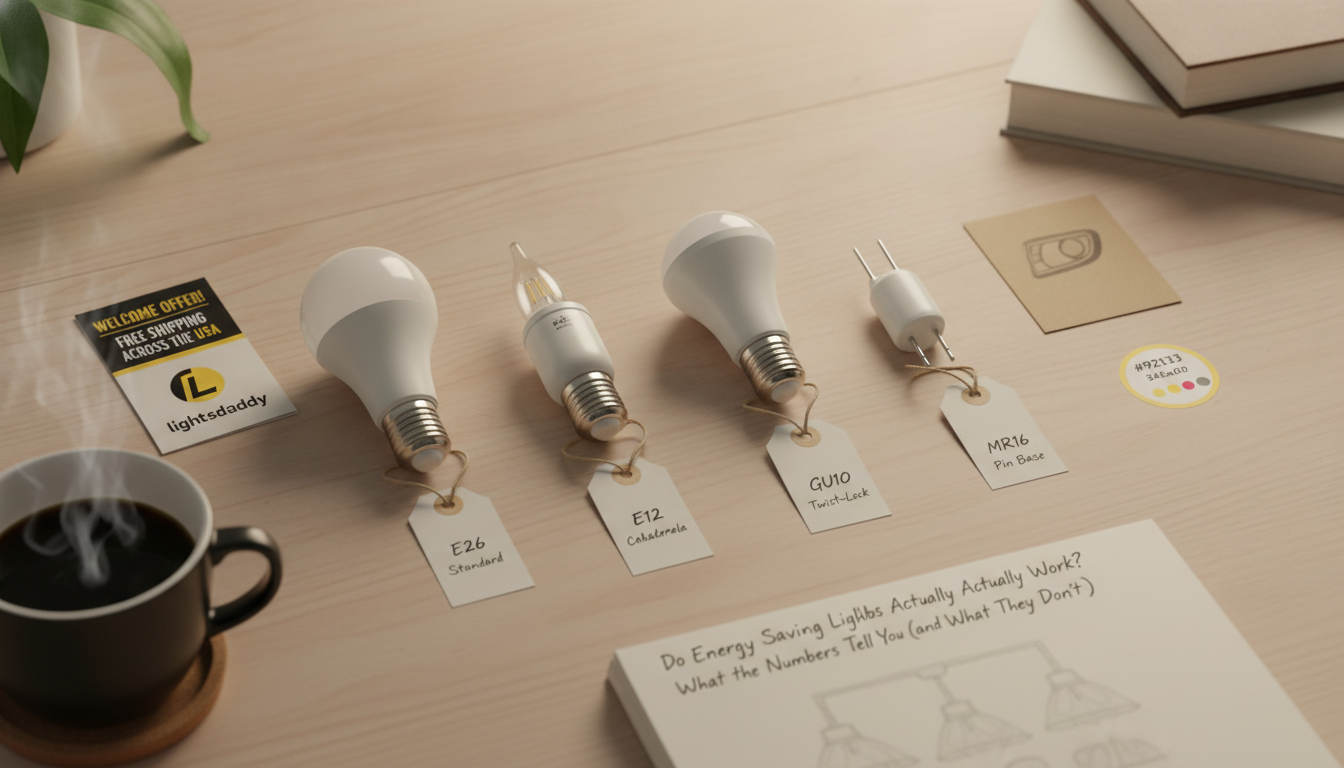
Base Type: The Detail That Ends the Return Trip
The most avoidable mistake when buying replacement bulbs is getting the base wrong. The E26 medium base is standard in most US household fixtures. But candelabra fixtures use the smaller E12 base. Track lighting often uses GU10 or MR16 bases. Bathroom vanity strips may use a completely different form factor.
Before you buy, pull the old bulb out and check the base. It takes 10 seconds and saves a trip back to the store — or a return shipment. When you're shopping online, filtering by base type is the fastest way to narrow down your options to bulbs that will actually fit.
If you're working through multiple rooms in your home, it's worth making a quick list: fixture type, current bulb wattage, base type, and whether the fixture is enclosed or open. That list turns what can feel like an overwhelming category into a straightforward checklist.
Our full bulb collection lets you filter by base type, wattage equivalent, and color temperature — which makes it a lot easier to match the right bulb to each fixture rather than guessing from the aisle.
Which Bulb Type Is Right for You?
For most households replacing standard fixtures, LED is the clear choice: instant-on, long lifespan, wide range of color temperatures, and available in nearly every base type. CFLs are still around but have largely been superseded. Halogen bulbs produce excellent color rendering and are fully dimmable, but they run hotter and use more energy than LEDs — they're worth considering for specific applications (like certain display lighting) but not as a general replacement strategy.
Specialty applications — automotive bulbs, miniature slide-base bulbs, novelty fixtures — have their own requirements, and it's worth checking compatibility before assuming a standard LED retrofit will work.
The bottom line: energy saving bulbs work, and the technology is mature enough that the early complaints about light quality and compatibility are largely solved — as long as you're buying the right bulb for the right fixture. The specs on the box are there to help you do exactly that. Learn to read lumens over watts, pick your color temperature intentionally, and check the base type before you order. That's really all it takes.
Ready to work through your fixture list? Browse LightsDaddy's bulb selection and filter by base type, wattage equivalent, and color temperature to find the right fit for every fixture in your home.
Frequently Asked Questions
Are LED bulbs really worth the higher upfront cost compared to incandescents?
For most fixtures, yes — especially ones that run for several hours a day. LEDs use significantly less electricity for the same light output, and their rated lifespan is much longer than incandescents, which means fewer replacements over time. The math works in your favor fastest on fixtures that run the most hours.
Why do some LED bulbs flicker or buzz on a dimmer switch?
Most older dimmer switches were designed to work with incandescent bulbs, which have a different electrical load than LEDs. The mismatch can cause flickering, buzzing, or an inability to dim smoothly. The fix is usually to use a bulb explicitly labeled as dimmable and pair it with a dimmer switch rated for LED loads. Both pieces need to be compatible — swapping just the bulb isn't always enough.
What color temperature should I use in different rooms?
A general rule: warm white (around 2700K) suits living rooms, bedrooms, and dining areas where you want a relaxed, cozy atmosphere. Neutral or cool white (3500K–5000K) works well in kitchens, bathrooms, home offices, and garages where you want clear, task-friendly light. Going too cool in a bedroom or too warm in a workspace is the most common reason people feel like a bulb "just doesn't look right."
Can I use any LED bulb in an enclosed ceiling fixture?
Not all LED bulbs are rated for enclosed fixtures. When a bulb is inside a closed glass cover, heat has nowhere to go — and excess heat shortens the lifespan of the LED's driver circuitry. Look for packaging that specifically says "enclosed fixture rated" or "suitable for enclosed fixtures" before installing an LED in a flush-mount or globe-style ceiling fixture.


