Cart
0
The pitch sounds great. The reality is more complicated.
Every home improvement article you read lately seems to assume you're already halfway through setting up a smart home. Smart bulbs, smart switches, voice control, app scheduling — it's presented as the obvious next step. But if you just want your living room to look good and your utility bill to stay manageable, the case for smart lighting isn't quite as clear-cut as the marketing makes it sound.
This isn't a hit piece on smart lighting. Some of it genuinely earns its place. But before you spend real money on a system that may or may not match how you actually live, it's worth being honest about what you're getting into — and what you're not.
What Smart Lighting Actually Does Well
Let's start with the legitimate wins, because there are real ones worth knowing about.
Scheduling and automation
This is the feature most people underestimate until they actually have it. Setting your porch light to turn on at sunset and off at midnight — automatically, every night — is genuinely useful. Same with having your bedroom lights dim gradually in the morning instead of snapping on at full brightness. If your household runs on a consistent routine, automation earns its keep quickly and with minimal effort on your part.
Dimming without a dimmer switch
Most smart bulbs are dimmable right out of the box, controlled through an app or a voice assistant, without any wiring changes. If you rent, or if your home has switches that aren't dimmer-compatible, this is a meaningful advantage. You get full ambiance control without touching the electrical panel — and without asking your landlord for permission.
Multi-zone control from one place
Grouping lights across rooms and adjusting them all from your phone — or setting scenes for movie night versus a dinner party — sounds gimmicky until you actually use it. For open-plan homes especially, it's a legitimate quality-of-life improvement that's hard to replicate with conventional switches.
Color temperature flexibility
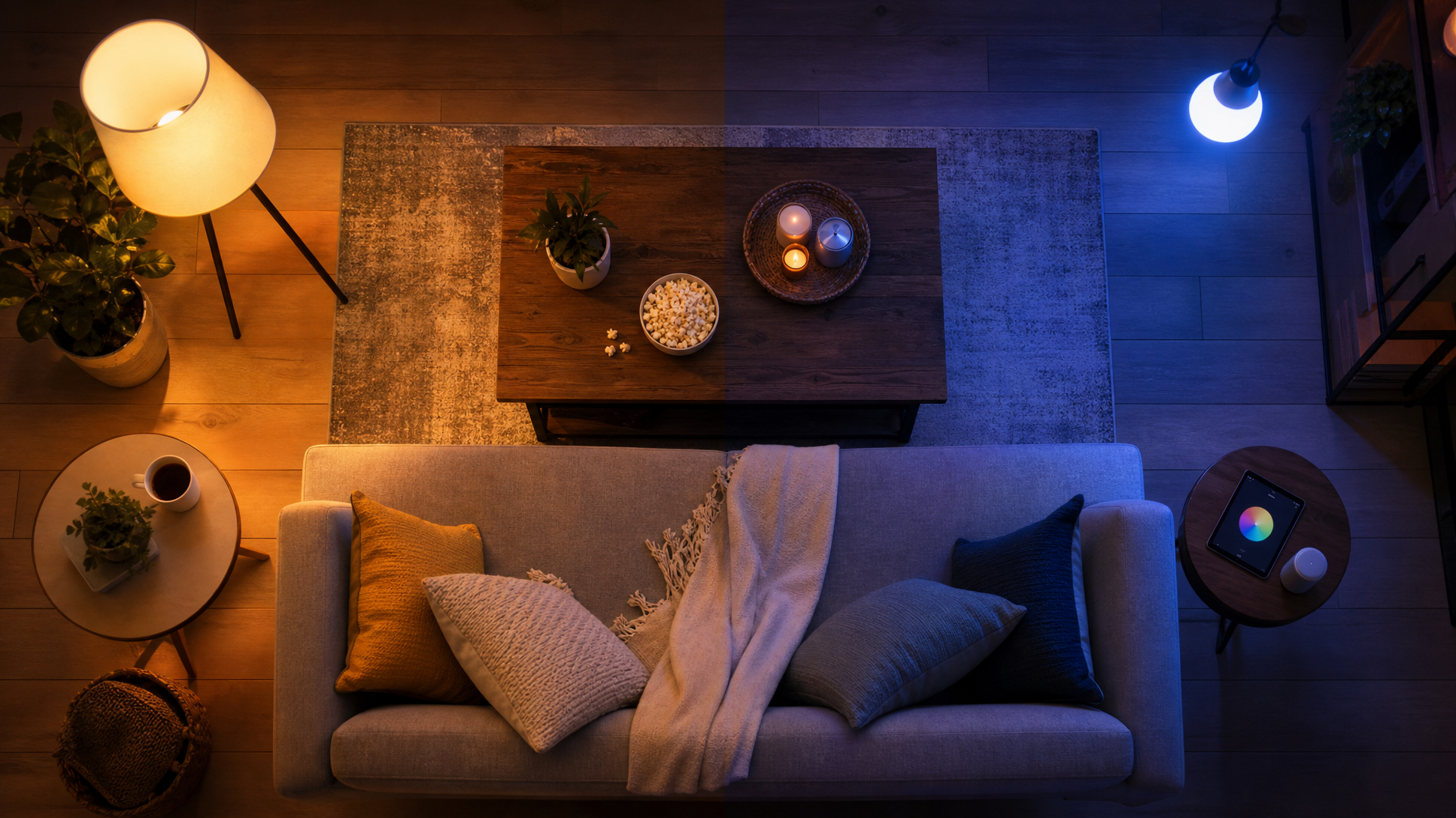
Tunable white bulbs let you shift between warm, cozy light in the evening and cooler, more alert light during the day. Light color temperature can meaningfully affect alertness and comfort, which is why this feature has moved well beyond novelty for a lot of households. It's one of the more practical reasons to consider smart bulbs in spaces where you spend several hours a day.
What Smart Lighting Costs You (Beyond the Sticker Price)
Here's where the honest conversation gets uncomfortable for the smart lighting industry.
The upfront cost is real
A quality smart bulb costs noticeably more than a standard LED equivalent. Multiply that across every socket in your home and the number climbs fast. If you're outfitting an entire house, you're looking at a significant investment before you've even considered a hub, a bridge, or any accessories the system might require.
Ecosystem lock-in is a genuine risk
Smart lighting systems are built around ecosystems — and those ecosystems don't always play nicely together. Buy into one brand's hub and you may find yourself locked into that brand's products, pricing, and support timeline. If the company discontinues a product line or shuts down its cloud service, your investment can become a collection of expensive hardware with no software to run it. This isn't hypothetical; it's happened to real customers of real brands, and it's worth factoring in before you commit.
It adds complexity to a simple task
Turning a light on should take one second. With smart lighting, that still works — until the app needs an update, the hub loses its connection, or your Wi-Fi hiccups at the wrong moment. For most rooms in most homes, that extra layer of complexity is solving a problem you didn't actually have. Convenience that occasionally fails to be convenient is a real drawback.
Not every room benefits equally
Your living room or home office? Smart lighting might genuinely improve your day. The bathroom light you flip on for 90 seconds? A motion sensor ceiling light does the same job for a fraction of the cost, with zero app required. Treating every fixture in your home as a smart lighting opportunity is how you end up overspending on features you never use in rooms where it never mattered.
The Case for Conventional LED — Which Is Still Very Good
Standard LED fixtures have come a long way, and it's easy to overlook just how capable they are. A well-chosen dimmable LED bulb in a quality fixture gives you excellent light output, long lifespan, and low energy draw — without a hub, an app, or any ecosystem to manage. For most rooms, that's still the right answer.
Motion sensor lights — the kind you'd use in a hallway, garage, laundry room, or closet — add real automation without any smart home infrastructure. A rechargeable ceiling light handles spaces where running new wiring isn't practical. These solutions solve genuine problems at a lower price point, with far less ongoing maintenance and no software updates to worry about. They're not a compromise; for the right spaces, they're simply the better tool.
If you want to explore what's available across both categories, LightsDaddy's full lighting collection covers everything from basic LED bulbs to motion-activated fixtures and specialty lighting, so you can compare options without committing to one approach before you're ready.
So, Is Smart Lighting Worth It? Here's the Honest Answer
It depends on two things: which rooms you're talking about, and whether you'll actually use the features you're paying for. Those two questions cut through more marketing noise than any spec sheet will.
Smart lighting makes sense in rooms where you genuinely want scheduling, dimming, or scene control — living rooms, bedrooms, home offices, and outdoor fixtures that benefit from consistent automation. In those spaces, the convenience is real and the cost can justify itself over time, especially if you're already working within an existing smart home ecosystem.
It does not make sense as a whole-home default. For utility spaces, rentals where switch modifications aren't an option, or anyone who simply wants reliable light without managing an app, a well-chosen conventional LED fixture is the smarter buy. Spend the money you save on a better fixture, a nicer shade, or a motion sensor that works without a Wi-Fi connection.
The one thing worth avoiding is buying smart lighting because it feels like the 'modern' choice, then never using the features that made it expensive. That's the most common way people end up disappointed — and it's entirely avoidable with a little upfront thinking.
A Simple Framework Before You Buy
- Would you actually use scheduling or automation in this room? If yes, smart lighting earns real consideration. If no, a standard LED or motion sensor will serve you better.
- Do you already have a smart home ecosystem? Adding to an existing setup costs less and causes fewer headaches than starting from scratch with a new hub and new apps.
- Is the room high-traffic or low-traffic? Low-traffic spaces — closets, hallways, garages — are almost always better served by a motion sensor than a smart bulb. Save the smart budget for where it counts.
- What's your realistic budget per fixture? Both smart bulbs and conventional LEDs have quality options at different price points. Know what you're willing to spend before you browse, so you're comparing the right things.
- How much ongoing maintenance are you comfortable with? Smart systems require occasional app updates, hub restarts, and compatibility checks. If that sounds like a chore rather than a hobby, lean conventional.
If you're thinking about adding accent or ambient lighting as part of a room upgrade, the LED Strip Lights Buying Guide is worth a read before you commit to anything.
Smart lighting isn't a scam — but it's not a universal upgrade either. Buy it where it solves a real problem in your home, and skip it where it doesn't. That's a more useful rule than any feature list a brand will give you, and it'll keep your budget pointed at things that actually improve your day.
Ready to find the right fit? Browse LightsDaddy's full lighting collection to compare smart fixtures, conventional LEDs, motion sensor lights, and more — all in one place, across every budget.
Frequently Asked Questions
Can I mix smart bulbs and regular LED bulbs in the same home?
Yes, and for most households that's actually the practical approach. Use smart bulbs in rooms where scheduling or dimming genuinely improves your routine, and stick with standard LEDs everywhere else. There's no rule that says your whole home has to run on one system — and mixing and matching often gives you the best value overall.
Do smart bulbs work if the Wi-Fi goes down?
It depends on the brand and setup. Many smart bulbs lose app and voice control when your Wi-Fi drops, though they often still function as a basic on/off light via the wall switch. Zigbee or Z-Wave based systems that use a local hub tend to be more resilient than purely Wi-Fi or cloud-dependent bulbs, since they don't rely on an internet connection for basic automation.
Are smart lighting systems compatible with all voice assistants?
Not universally. Most major smart lighting brands support at least one or two popular voice platforms, but compatibility varies by product and can change when manufacturers update their software. Always check the specific product's compatibility list before buying — especially if you're already invested in a particular voice assistant ecosystem.
What's the most cost-effective way to add automation to a room without buying smart bulbs?
A motion sensor ceiling light or a plug-in smart outlet are both solid alternatives. Motion sensor fixtures handle the most common automation need — lights that turn on when someone enters and off when they leave — without any app, hub, or ongoing ecosystem to manage. For lamps and plug-in fixtures, a smart plug can add basic scheduling at a lower cost per socket than replacing every bulb.