Cart
0
Most people buying a desk lamp for a small workspace make the same mistake: they pick based on looks, plug it in, and then spend the next six months annoyed by a base that blocks half their notepad or a shade that throws light at the wall instead of the page. A lamp that works beautifully on a spacious studio desk can be genuinely useless on a compact home office setup or a dorm table.
The good news is that getting focused, comfortable task light in a tight space isn't hard — you just need to know which features actually matter and which ones are marketing fluff. Here's a practical breakdown, with real lamps as examples of different approaches.
What Small-Space Desk Lighting Actually Comes Down To
Before jumping to specific lamps, it helps to know the three things that separate a small-space winner from a space-waster:
- Base footprint. A wide, heavy base looks stable but can claim more real estate than you'd expect. For tight desks, a compact round or oval base wins every time.
- Neck flexibility. A fixed-angle lamp forces you to rearrange your whole setup to get the light where you need it. A flexible goose neck lets you aim precisely — toward a book, a keyboard, a sketchpad — without moving anything else.
- Shade direction and size. A wide, flat shade spreads light broadly (good for ambient, less good for focused task work). A directional shade concentrates light on your actual work surface, which is what you want when space is limited and you need to stay focused.
With those in mind, here are five desk lamp approaches worth knowing — and two concrete picks from LightsDaddy's desk lamp lineup to illustrate the range.
1. The Classic Goose Neck: Maximum Adjustability, Minimal Footprint
The goose neck is the workhorse of small-space lighting, and for good reason. The flexible metal neck bends and holds position, so you can angle the light exactly where it's needed without repositioning the lamp itself. The base stays put in one corner of your desk while the head does all the work.
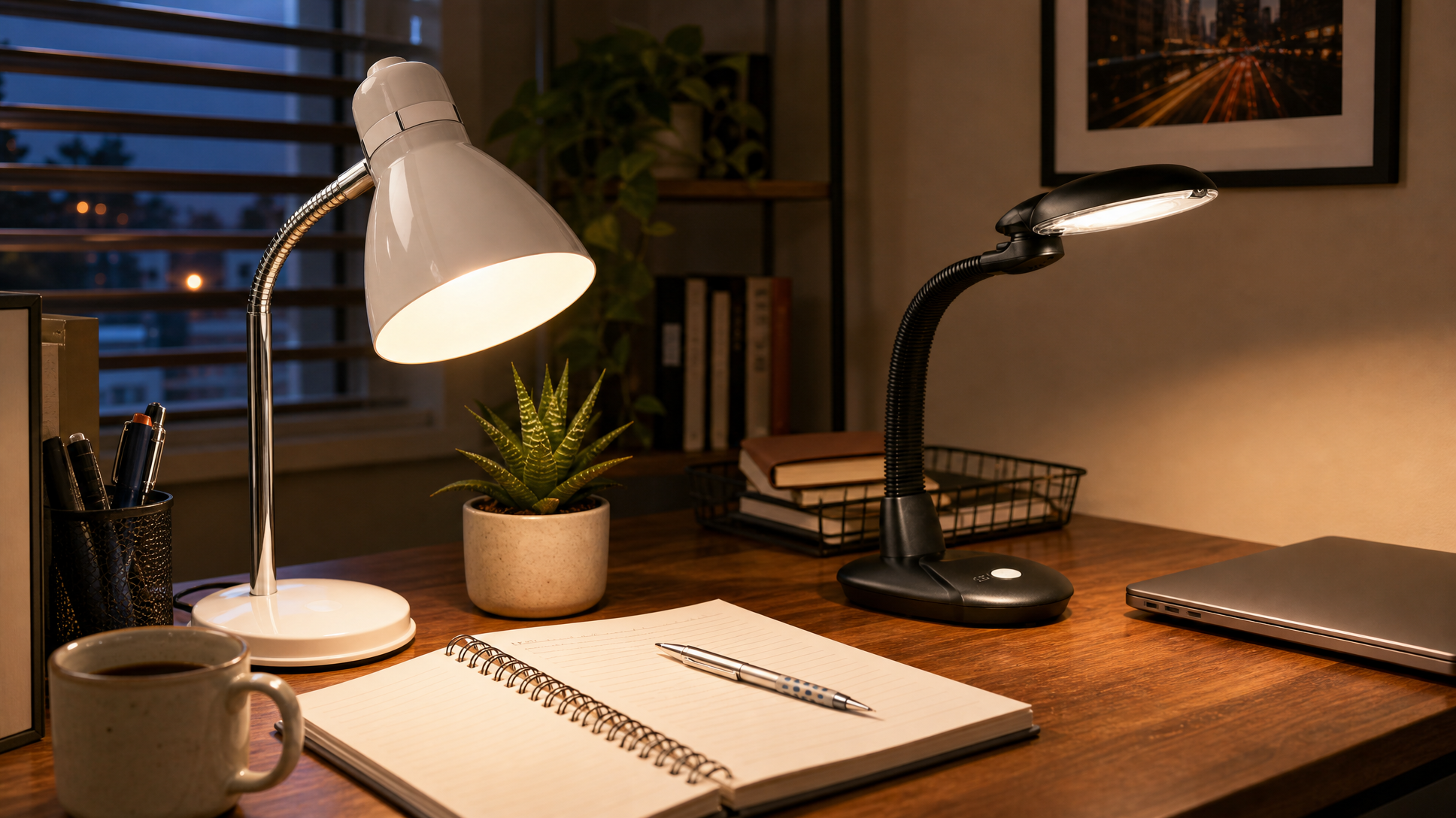
The Newhouse Lighting Oxford Flexible LED Goose Neck Desk Lamp is a clean example of this done right. It's built from metal — a sturdy base and a proper goose neck with a chrome accent — finished in white, so it reads as tidy and unobtrusive on a light-colored desk. The directional shade points light downward onto your work surface rather than scattering it around the room, and it comes with a 6-watt LED bulb included, so there's nothing extra to buy before you can use it. For anyone who needs to light a specific zone — a planner, a keyboard, a book — without the lamp taking over the desk, this style delivers.
2. The Natural-Light Simulator: Better for Eye-Intensive Work
If you spend long stretches doing detail work — reading fine print, crafting, drawing, editing photos — the quality of light matters as much as its direction. Standard cool-white bulbs can cause fatigue over time. Lamps designed to simulate natural daylight produce a broader, more balanced spectrum that's easier on the eyes during extended sessions.
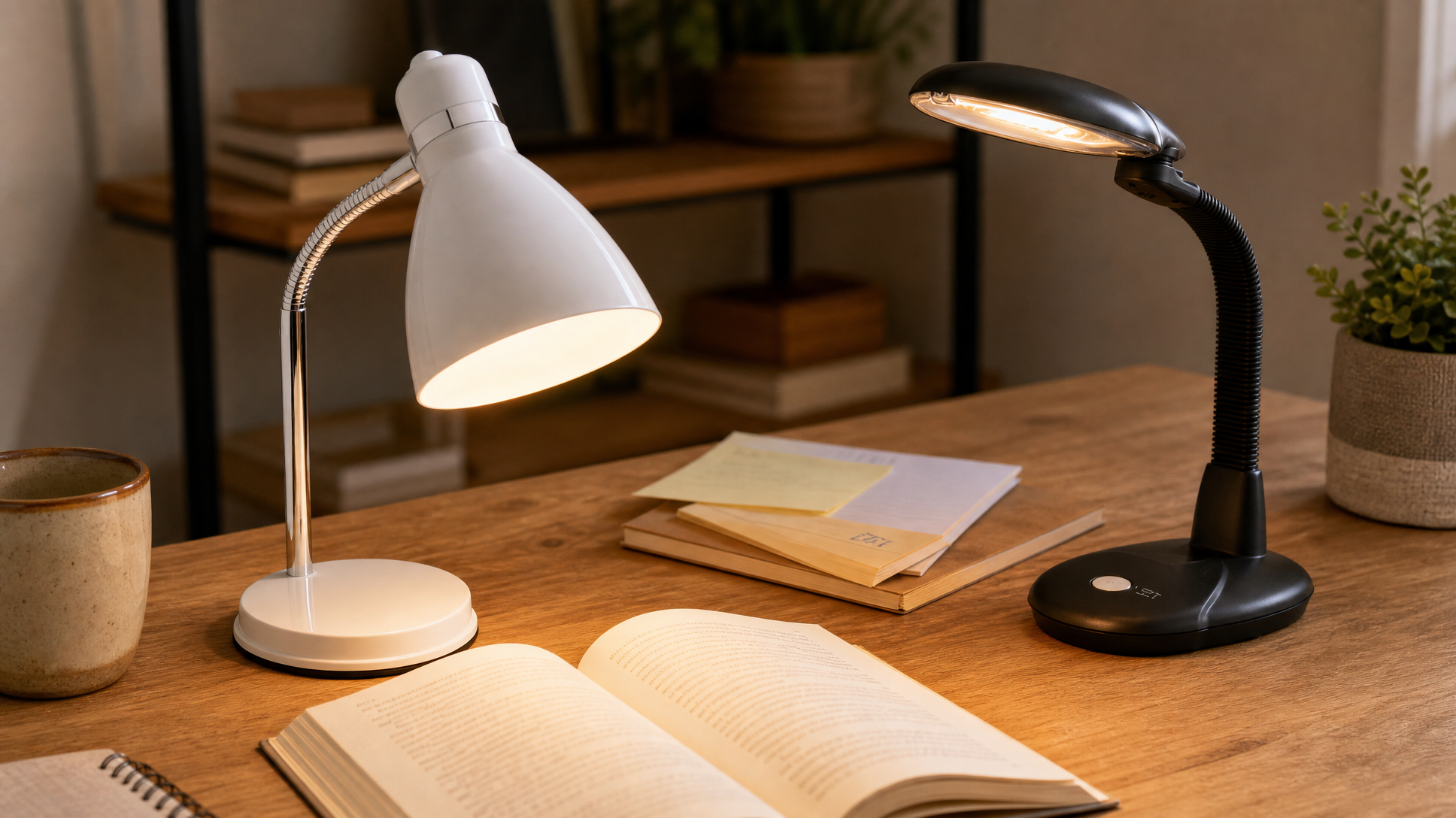
The SPT EasyEye SL-823B Energy Saving Desk Lamp takes this approach. It uses a 2-tube design with a wide, flat head that spreads bright white light across a broad area, engineered to simulate natural lighting. The flicker-free technology (driven by an advanced IC chip) is the key feature here — flicker is often invisible to the naked eye but contributes to eye fatigue over time, so eliminating it makes a real difference during long work sessions. The black and gray finish gives it a functional, no-nonsense look. The trade-off: the wider head means it covers more surface area, so it's better suited to a desk where you want even illumination across a wide zone rather than a pinpoint spotlight on one small area.
3. The Clip-On: Zero Base, Zero Footprint
If your desk is genuinely tiny — a wall-mounted shelf, a narrow console, a standing desk with barely any surface — a clip-on lamp removes the base equation entirely. It clamps to the edge or a monitor arm and hangs the light overhead or to the side, freeing up every inch of the surface. The trade-off is that clip-ons are typically less stable than freestanding lamps and the clamp can mark softer desk surfaces over time.
4. The Touch-Dimmer Lamp: Fewer Switches, More Control
On a crowded desk, a lamp with a rotary switch or a cord-mounted toggle is a minor daily frustration — you're always reaching around things to find it. Touch-dimmer lamps let you tap the base or the neck to cycle through brightness levels, which is genuinely more convenient in a tight space where the lamp is tucked into a corner. Look for models with at least two or three brightness steps so you can dial down for screen work and up for reading without swapping bulbs.
5. The Minimalist LED Panel: Ultra-Flat, Ultra-Focused
For the most space-conscious setups, flat LED panel lamps have almost no depth to their head — they look more like a thin paddle than a traditional shade. They typically sit on a slim weighted base and throw a wide, even wash of light directly downward. They're not the most adjustable option, but if your desk layout is fixed and you just need consistent, shadow-free light over a specific zone, they're hard to beat for the footprint they occupy.
The Bottom Line
A small desk doesn't call for a small lamp — it calls for the right lamp. Nail the base footprint, get a neck that bends where you need it, and match the light quality to the work you actually do. Everything else is secondary.
Browse the full desk lamp collection at LightsDaddy to find the right fit for your workspace — there's a range of styles and price points, and both lamps featured here are in stock and ready to ship.
Frequently Asked Questions
What size desk lamp base is best for a small desk?
A compact round or oval base — roughly the size of a coffee mug's footprint — is ideal for tight spaces. Avoid wide rectangular bases, which can block notepads or keyboards even when the lamp is pushed to a corner. Goose neck lamps with a small circular base, like the Newhouse Lighting Oxford, are a reliable choice for this reason.
Is a goose neck lamp better than a fixed-arm lamp for a small workspace?
Generally, yes. A flexible goose neck lets you redirect light without physically moving the lamp, which matters a lot when desk space is limited. A fixed arm locks you into one angle, so if your work surface changes throughout the day — laptop here, notebook there — you'll find yourself constantly working around the light rather than with it.
What does "flicker-free" mean in a desk lamp, and does it matter?
Flicker refers to rapid, often imperceptible fluctuations in light output that some bulbs and lamp drivers produce. While you usually can't see it directly, flicker can contribute to eye fatigue and headaches during long work sessions. Flicker-free lamps — like the SPT EasyEye SL-823B, which uses IC chip technology to eliminate it — are worth prioritizing if you spend several hours a day under your desk lamp.
Do I need to buy a bulb separately for a desk lamp?
It depends on the lamp. Some come with a bulb included — the Newhouse Lighting Oxford, for example, includes a 6-watt LED bulb so you can use it straight out of the box. Others require you to source a compatible bulb separately. Always check the product listing before buying so you're not caught without a bulb on day one.