Cart
0
The pitch sounds good. The reality is more complicated.
Every few months, a new smart lighting brand runs ads showing a sleek app, color-changing bulbs, and a homeowner tapping their phone to set the mood. If you run a small business, you've probably seen those ads and thought: could this work for my space? Then you've probably thought: but who's going to manage an app when we're slammed on a Saturday?
That instinct is right. Smart lighting for commercial spaces is a genuinely different conversation than smart lighting for homes. The questions that matter — zone control, durability under daily staff use, whether the energy math actually works — rarely get answered in the marketing. So let's answer them.
First, what "smart lighting" actually means in a commercial context
In a home, smart lighting usually means app-controlled bulbs, maybe a voice assistant, and the ability to dim or change color from your couch. In a small business, the useful version of smart lighting looks different: it's about zone control (being able to set different light levels for your retail floor versus your stockroom), scheduling (lights that turn on before staff arrive and off after they leave), and occupancy sensing (so your back office isn't burning electricity for eight hours when it's empty half the day).
Anything beyond those three functions — color scenes, voice control, app animations — is largely a home feature dressed up in commercial clothing. Useful to know before you spend on it.
Where smart lighting genuinely earns its cost in a small business
Spaces with variable occupancy
If you have a storage room, a back office, a changing room, or a hallway that gets used sporadically, motion-sensor lighting pays for itself faster than almost any other upgrade. The lights are simply off when nobody's there. No behavior change required from staff, no app to manage. A good motion sensor ceiling light handles this automatically — and that's the kind of "smart" that actually sticks in a busy commercial environment.
Businesses where ambiance is part of the product
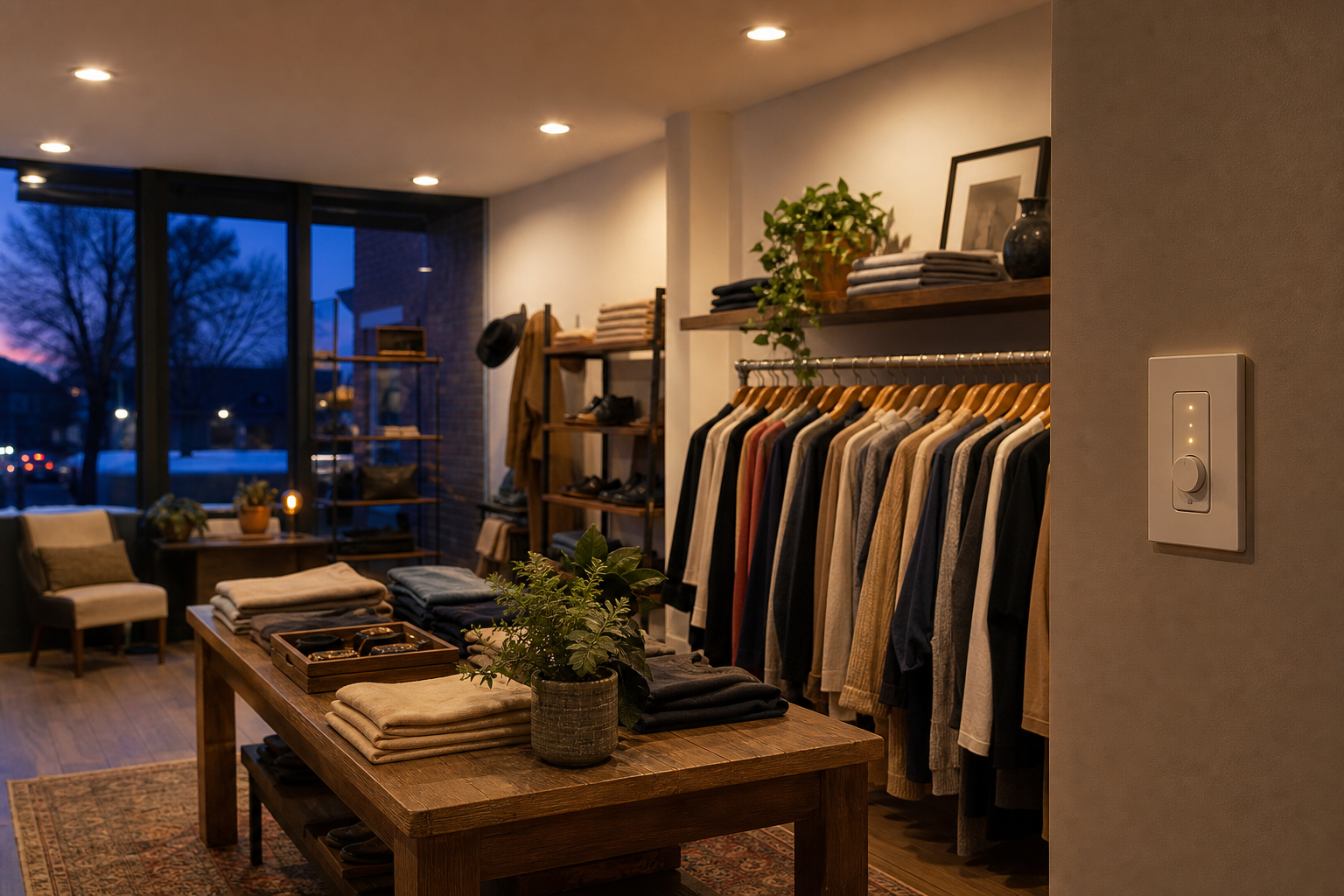
A restaurant moving from lunch service to dinner, a spa transitioning between treatment rooms, a boutique that wants a different feel for an evening event — these are cases where the ability to shift light levels or color temperature across zones has real commercial value. Guests notice, even when they don't consciously register it. If your revenue depends partly on atmosphere, dimmable and zone-controlled lighting is worth the investment.
Spaces with high lighting hours
A business that runs lights for ten or more hours a day, six or seven days a week, accumulates serious energy costs over a year. Scheduling — lights on at opening, off at close, reduced during slower midday hours — can meaningfully reduce that bill without anyone having to remember to flip a switch. This is where intelligent lighting systems start to pencil out financially, especially combined with LED sources that are already efficient at baseline.
Where a simpler LED upgrade is the smarter call
Here's the honest part: for a lot of small businesses, the biggest lighting win isn't going smart — it's going LED if you haven't already, or replacing aging fixtures with better-quality LED options.
If your shop floor is lit by fluorescent tubes that hum, flicker, and render colors badly, swapping to high-CRI LED panels will do more for your customer experience and your energy bill than any app-controlled bulb. Same for a salon: the right color temperature under which stylists can accurately see hair color is a practical, non-negotiable need. A smart bulb that shifts to warm amber at sunset is a problem, not a feature, in that context.
The rule of thumb: fix the fundamentals first. Good light quality, consistent output, and the right color temperature for your specific tasks. Add intelligence on top of that only where it solves a real operational problem.
The durability question no one talks about
Smart bulbs and fixtures designed for home use are typically rated for occasional interaction — a homeowner adjusting a lamp a few times a week. In a commercial setting, switches get flipped dozens of times a day by different staff members. Some smart systems behave unexpectedly when a physical switch cuts power to them (they lose their programmed state, or reconnect slowly). That's a minor annoyance at home. In a busy salon or cafe, it becomes a genuine operational friction.
If you're speccing smart lighting for a commercial space, look specifically for fixtures and systems designed to handle that kind of use — or plan your installation so that physical switches aren't in the equation at all (using smart switches at the panel level rather than at the bulb). Rechargeable, battery-backed ceiling lights can also solve specific spots where wiring is a constraint, without adding network complexity.
Does the energy savings actually pencil out?
This depends heavily on your specific situation — your current fixtures, your operating hours, your local electricity rates — so anyone giving you a precise number without knowing those details is guessing. What's generally true: the energy savings from switching to LED are real and relatively quick to realize. The additional savings from adding smart controls on top of LED are meaningful in spaces with variable occupancy or long operating hours, and modest in spaces that are consistently occupied and already well-managed.
If you're still on incandescent or older fluorescent fixtures, the LED switch alone is almost certainly the highest-return move. Smart controls are the next layer, not the first one.
A practical framework for small business owners
- Audit by zone. Walk your space and categorize each area: always occupied, sometimes occupied, rarely occupied. Rarely-occupied zones are your best candidates for motion-sensor or scheduled lighting.
- Identify your task-critical areas. Anywhere color accuracy or consistent light levels matter (a styling chair, a fitting room, a food prep area) — prioritize quality LED sources over smart features.
- Calculate your hours. If a zone runs lights for more than eight hours a day, scheduling or occupancy sensing has a real payback case. Under four hours, the math gets thinner.
- Choose durable over clever. In a commercial setting, a fixture that works reliably every time is worth more than one with features you'll stop using in a month because they're fiddly.
If you're also thinking about outdoor signage lighting, parking lot fixtures, or vehicle lighting for a fleet or delivery van, the same principle applies — LED first, smart controls where there's a clear operational reason. Our guide on automotive lighting upgrades covers what's worth doing yourself versus calling in a pro, which is useful context if your business involves vehicles.
Smart lighting for small businesses isn't a yes-or-no answer — it's a zone-by-zone decision. Get the fundamentals right, add intelligence where it solves a real problem, and don't pay for features your staff will route around by lunchtime.
LightsDaddy stocks LED and specialty lighting solutions for both residential and commercial spaces — browse by category or reach out if you need help speccing a space.
Frequently Asked Questions
Can I use home smart lighting products in a commercial space?
Technically yes, but with caveats. Home smart bulbs and fixtures are typically designed for lighter use patterns — occasional adjustments by one or two people. In a commercial environment with multiple staff members and high daily switch cycles, you may run into reliability issues or find that the smart features (app control, scheduling) break down when physical switches cut power unexpectedly. Where possible, look for commercial-rated fixtures or plan your installation to minimize physical switch interactions with smart devices.
What color temperature is best for a retail or salon environment?
For retail spaces where product color matters — clothing, cosmetics, food — a higher color rendering index (CRI) is more important than any specific color temperature. Look for LEDs rated at a high CRI so colors appear accurate and appealing under your lighting. Salons generally benefit from a neutral to cool-white temperature that lets stylists see true hair color, rather than warm-toned bulbs that shift perception. The right choice depends on your specific products and tasks, so it's worth testing a fixture in your actual space before committing.
How long does it typically take to recoup the cost of an LED upgrade in a small business?
Payback period varies depending on your current fixtures, local electricity rates, and how many hours a day your lights run. What's consistently true is that businesses replacing older incandescent or fluorescent fixtures with LED tend to see meaningful energy reductions, and the longer your operating hours, the faster the payback. Adding smart controls (scheduling, occupancy sensing) on top of LED can shorten the payback further for spaces with variable or unpredictable occupancy. Anyone giving you a precise timeframe without knowing your specific setup is estimating — your best move is to calculate based on your own utility bills and operating hours.
Do I need an electrician to install smart lighting in a small business?
It depends on what you're installing. Smart bulbs that screw into existing sockets are a straightforward DIY swap. Hardwired smart switches, panel-level controls, or new fixture installations typically require a licensed electrician, especially in a commercial space where building codes and insurance requirements may apply. If you're unsure, it's always safer and often required by code to have a professional handle anything involving your electrical panel or permanent wiring.