Cart
0
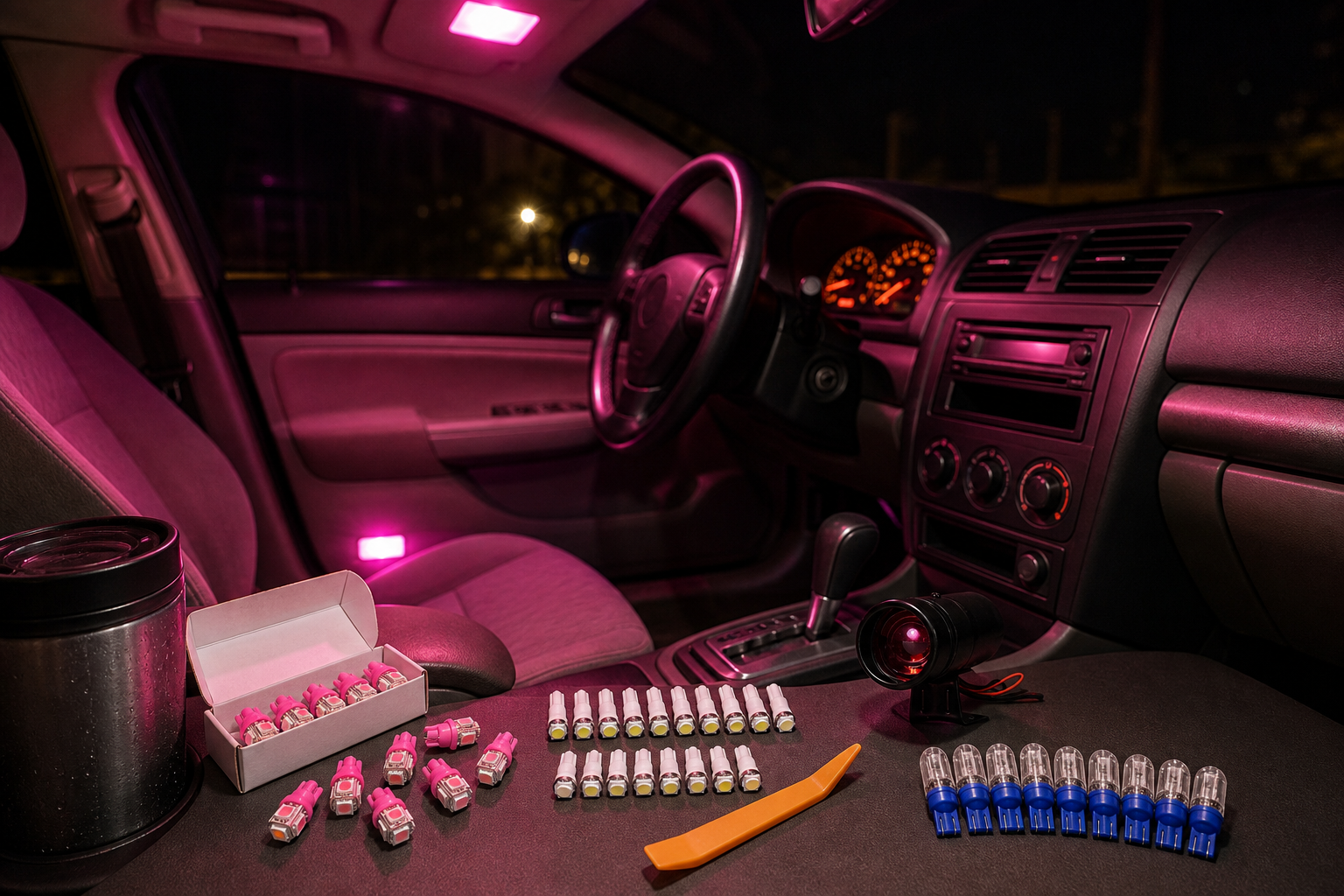
The moment you realize your stock dome light looks like a hospital waiting room, you start shopping for LED replacements. Then you hit the color options and freeze. Pink? White? Blue? They all look great in product photos, but what do they actually do inside a car at night — and does it matter which socket you put them in?
It does matter, more than most guides let on. Here's a practical breakdown of each color, where it works best, and the real trade-offs — using four products that cover the full range of what an interior LED build actually involves.
First: Why Color Temperature Matters in a Car Cabin
Your car's interior lighting serves two very different jobs depending on when you use it. At night, you need just enough light to find your keys or read a parking ticket without killing your night vision. During a build or a detailing session, you want clarity. The color you choose affects both.
Warm or colored LEDs (pink, amber) tend to feel softer and less jarring in the dark. Cool whites and blues read as brighter and crisper — better for functional visibility, but harsher on the eyes if you're sitting in a dark parking lot. Neither is objectively wrong. It depends on what you're optimizing for.
Pink: The Custom-Build Statement Color
Pink interior lighting is a deliberate choice. Nobody accidentally buys pink. If you're going this route, you already know what you want — a cabin that looks unmistakably custom, especially after dark when the color really shows.
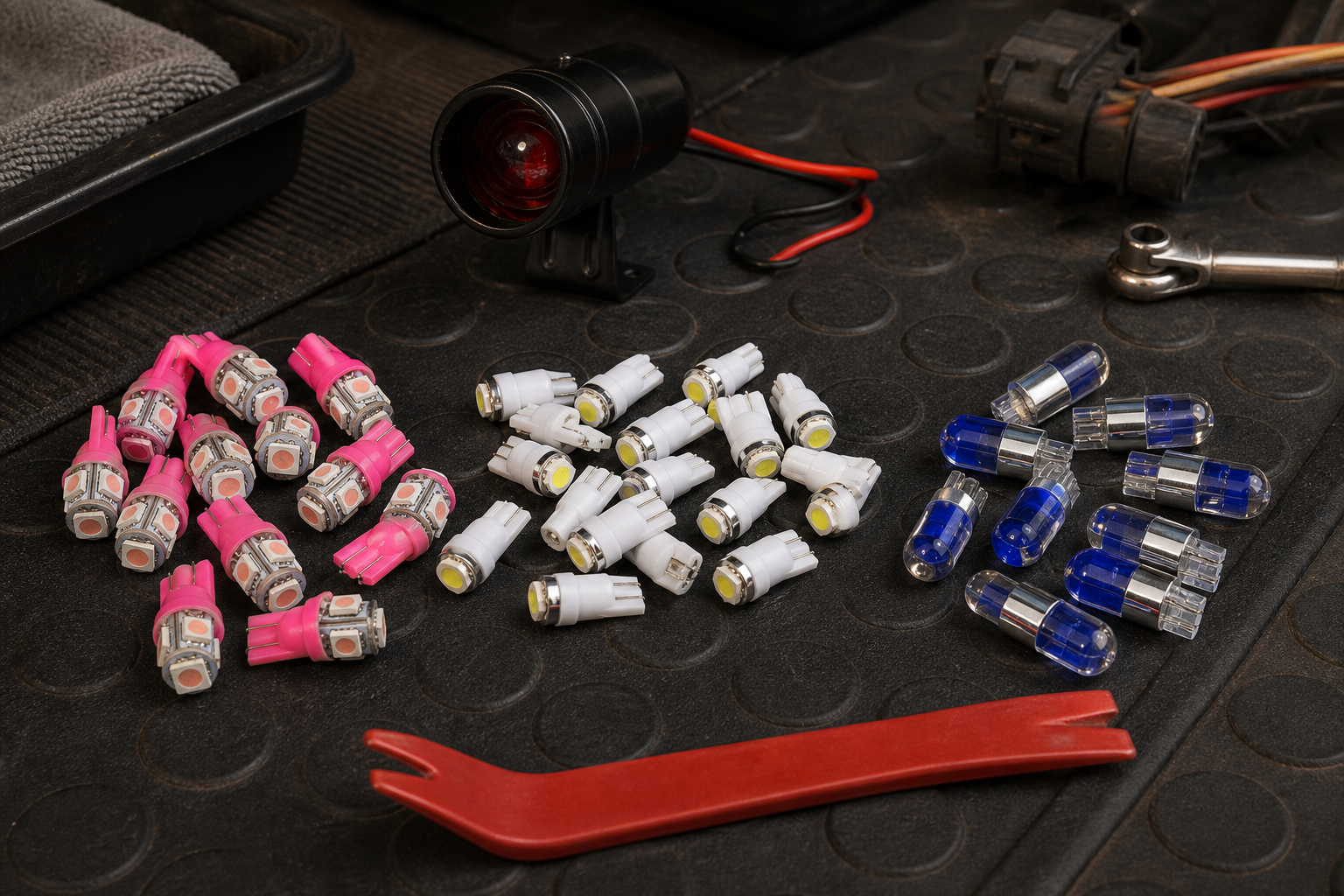
The Blyilyb 12-Pack Pink T10 194 LED Bulbs are built for exactly this. Each hot-pink bulb uses five 5050 SMD LEDs arranged radially — you can see the circular cluster clearly in the photo — and the whole set runs at 12V DC with a rated output of 80 lumens per bulb and a draw of just 0.8W each. The pack replaces stock numbers 194, 158, 168, 175, 2825, and 912, which covers most of the interior sockets you'd want to hit: dome, map, vanity, trunk, courtesy, license plate, and dashboard.
Where pink works best: dome lights, courtesy lights (the ones in door panels), and trunk lights — anywhere the color becomes part of the atmosphere rather than a functional reading light. Pink on a dashboard gauge cluster can make the numerals harder to read at a glance, so it's worth being selective.
The trade-off is honesty: pink is a style choice, not a visibility upgrade. If you're building a themed interior and want every socket glowing the same warm-pink tone, a 12-pack gives you enough coverage to do it properly without mixing batches.
White: The Clean Factory-Plus Look
Most people who upgrade their interior LEDs for the first time go white. It's the safest choice, and for good reason — a crisp, cool white makes the cabin feel more modern and significantly brighter than the yellowish stock incandescents most vehicles ship with, without drawing attention to itself.
The cciyu T5 LED Wedge Bulbs — 20-Pack White are worth calling out here because they're aimed at a specific socket type most people overlook: T5 wedge bulbs, which live behind your dashboard gauge cluster and instrument panel. These are the tiny bulbs that backlight your speedometer, fuel gauge, and warning indicators. The stock versions go dim and yellow with age, and swapping them for the cciyu 1-SMD 5050 units — each one a compact 5mm diameter, 18mm height — gives the instrument panel a noticeably cleaner, more modern look without changing the color of your gauge markings.
White is also the practical choice if your car sees a lot of nighttime use where you actually need to read things — maps, receipts, the back seat. It renders detail well without the color cast that pink or blue introduces.
The only downside: white can look clinical in a custom build. If you're going for atmosphere over function, it's the least exciting option. But if you want your car to look like it rolled off the lot with better-spec lighting, white is the move.
Blue: The Middle Ground That Divides Opinion
Blue interior LEDs sit between white and pink in terms of customization level. They read as noticeably non-stock without being as polarizing as pink, and at night they produce a cool, slightly futuristic glow that a lot of enthusiasts associate with a performance-oriented build.
The TORYOR 194 LED Bulb Blue — Pack of 10 uses COB (chip-on-board) technology rather than individual discrete SMD LEDs, which produces a more even, diffused light output across the bulb face. The product is described as offering 360-degree illumination with no visual blind spots — useful in dome and map light applications where you want the light to spread across a wider area rather than concentrate in one direction. It's compatible with the same T10/W5W/194 socket family as the Blyilyb pink set, so the two could technically be mixed and matched if you wanted different colors in different zones of the cabin.
Where blue works well: dome lights, door courtesy lights, and license plate lights. Where it gets tricky: dashboard and gauge applications, where blue can create glare or wash out certain indicator colors depending on your cluster design. Test one bulb before committing the whole pack to the instrument panel.
The honest trade-off with blue is that it's the color most likely to look great in photos and slightly off in person, depending on your interior color. Dark interiors (black or charcoal) carry blue well. Beige or tan interiors can make it look a bit cold and out of place.
One More Thing: Don't Forget the Tachometer
If you're doing a full interior refresh on a performance-oriented build, the gauge cluster lighting is only part of the picture. The ESUPPORT Red LED Adjustable Tachometer — 1000-11000 RPM Shift Light is a different category of interior lighting entirely: it's a functional shift indicator, not a cosmetic bulb swap. The cylindrical black ABS housing mounts to the dash with a bracket and uses a red LED to signal the optimal RPM point for gear shifts. It's adjustable across a wide RPM range, which makes it compatible with a variety of engine setups.
It's worth mentioning here because it's the one piece of interior lighting where color is dictated by function, not style. Red is used specifically because it's attention-grabbing without being blinding — the same reason red is used for warning lights universally. If you're building a cabin that's performance-focused, the shift light's red LED can actually anchor the color story for the rest of your interior lighting choices.
How to Actually Decide
Here's the short version:
- Go white if you want a cleaner, brighter cabin that still looks stock-adjacent. Best for daily drivers and anyone prioritizing visibility over style.
- Go blue if you want a custom look that's subtle enough for most builds and works especially well in dark interiors. Test one bulb in your dome first.
- Go pink if the build has a theme and you're committed to it. Don't half-commit — a 12-pack lets you do the whole cabin consistently, which is the only way pink actually works.
- Mix intentionally if you're building zone by zone: white for the instrument cluster (where readability matters), color for dome and courtesy lights (where atmosphere matters).
The socket compatibility across these products — T10, T5, 194, W5W — means you're not locked into one brand or one color. You can match the right bulb to the right job, which is how a real build comes together.
Ready to pick your color? Browse the full range of automotive lighting and accessories at LightsDaddy and find the exact pack size and shade your build needs. And if you're still figuring out which upgrades are worth doing yourself, our guide on automotive lighting upgrades: what you can swap yourself vs. what needs a pro is a good next read.
Frequently Asked Questions
Will colored LED bulbs (pink or blue) affect my dashboard warning lights?
Colored bulbs in dome, map, and courtesy sockets won't interfere with your warning lights — those are separate circuits. The risk is in the instrument cluster: if you put a strongly colored bulb behind your gauge backlight, it can shift the apparent color of your indicator markings. For the gauge cluster, white or the OEM color is almost always the safer call.
What does T10, T5, and 194 mean — and how do I know which socket my car uses?
These are bulb base size designations. T10 and 194 are largely interchangeable terms for the same wedge-base socket family, which is the most common interior socket in most passenger vehicles. T5 is a smaller wedge base used specifically in instrument panels and gauge clusters. The easiest way to confirm what your car uses is to pull one of the existing bulbs and match the base size, or check your owner's manual's bulb reference chart.
Can I mix different colors in different parts of the same cabin?
Yes, and many builds do exactly this. A common approach is white for the instrument cluster (for readability) and a custom color — blue or pink — for dome, door, and trunk lights where the aesthetic effect matters more than precision visibility. The key is to be intentional about the zones so it looks deliberate rather than mismatched.
Do LED interior bulbs require any special wiring or resistors?
For most interior applications — dome, map, courtesy, trunk, license plate — standard T10 and 194 LED replacements are a direct plug-in swap with no additional wiring needed. Some vehicles with newer electronics may show a "bulb out" warning on the dash because LEDs draw less current than the original incandescent; in those cases, a load resistor can resolve it. The TORYOR blue pack is described as error-free, which suggests it's designed to address this, but always verify compatibility with your specific vehicle before buying.