Cart
0
Most lighting guides assume you're working with a vaulted great room or a lofty open-plan kitchen. You're not. You have eight feet — the standard ceiling height in the vast majority of American homes — and the wrong fixture will make that room feel like a storage closet before you even hang a picture.
The good news: eight-foot ceilings are very livable, and the right lighting strategy can make a room feel open, layered, and intentional. The bad news: there are a handful of very easy mistakes to make, and they're everywhere.
First, Understand the Actual Constraint
Eight feet sounds like plenty of room. But subtract the fixture itself, the mounting hardware, and the minimum clearance you need above people's heads, and the math gets tight fast. A general rule of thumb is that any hanging element — pendant, chandelier, semi-flush — should clear at least seven feet from the floor in a walkable area. That leaves you roughly twelve inches of drop from an eight-foot ceiling before you're encroaching on that clearance.
That one foot of usable drop is the number that should guide every fixture decision you make in a low-ceiling room.
Flush Mount vs. Semi-Flush: Know the Difference Before You Buy
These two fixture types do the same job but behave very differently in the room.
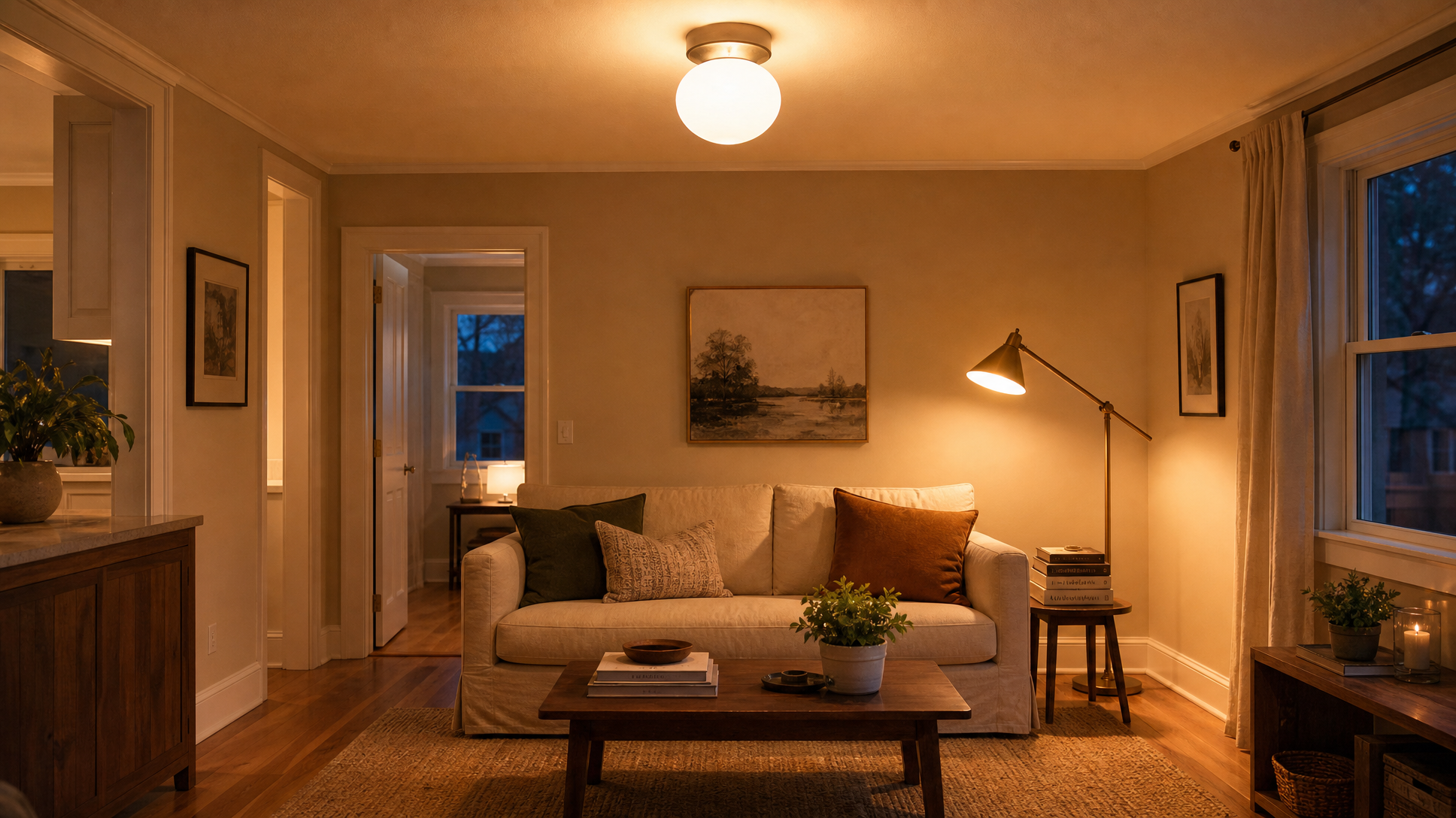
Flush mounts sit directly against the ceiling with no gap. They're the safest choice for eight-foot ceilings in bedrooms, hallways, and smaller rooms where overhead clearance is a real concern. The trade-off is that they tend to cast light downward in a single pool, which can feel flat. Choose one with a diffused shade rather than a bare bulb — it'll spread light more evenly and reduce harsh shadows.
Semi-flush mounts hang a few inches below the ceiling, usually between four and eight inches, on a short stem or canopy. That small drop actually makes a meaningful visual difference: it gives the fixture a little breathing room, makes it look more intentional than a flat disc stuck to the ceiling, and often allows for a larger shade or globe that throws more ambient light around the room. For an eight-foot ceiling, a semi-flush with a four-to-six-inch drop is typically the sweet spot.
The mistake people make here is buying a semi-flush rated for a nine- or ten-foot ceiling — they're often designed with a longer stem that eats up too much of your clearance. Always check the total hanging length before you order.
Pendants and Chandeliers: Yes, But With Conditions
Pendants are not off the table for eight-foot ceilings — they're just off the table in the wrong spots. Over a dining table or kitchen island, a pendant can work beautifully because people aren't walking under it. The standard guidance for dining pendants is to hang the bottom of the shade roughly 30 to 36 inches above the tabletop, which on an eight-foot ceiling leaves comfortable clearance above.
What you want to avoid: a chandelier with a long chain or rod in a space where people walk underneath it. And avoid anything with a dramatic downward tier — those designs are engineered for rooms with ten-foot ceilings or higher, and they'll visually drag your ceiling down even if they technically clear your head.
If you love the look of a chandelier, look for flush-style or semi-flush chandeliers — sometimes called hugger chandeliers — that give you the layered visual interest without the drop.
Recessed Lighting: Size Matters More Than You Think
Recessed cans are a popular answer for low ceilings because they don't take up any visual headroom at all. But the size of the can determines how the room feels.
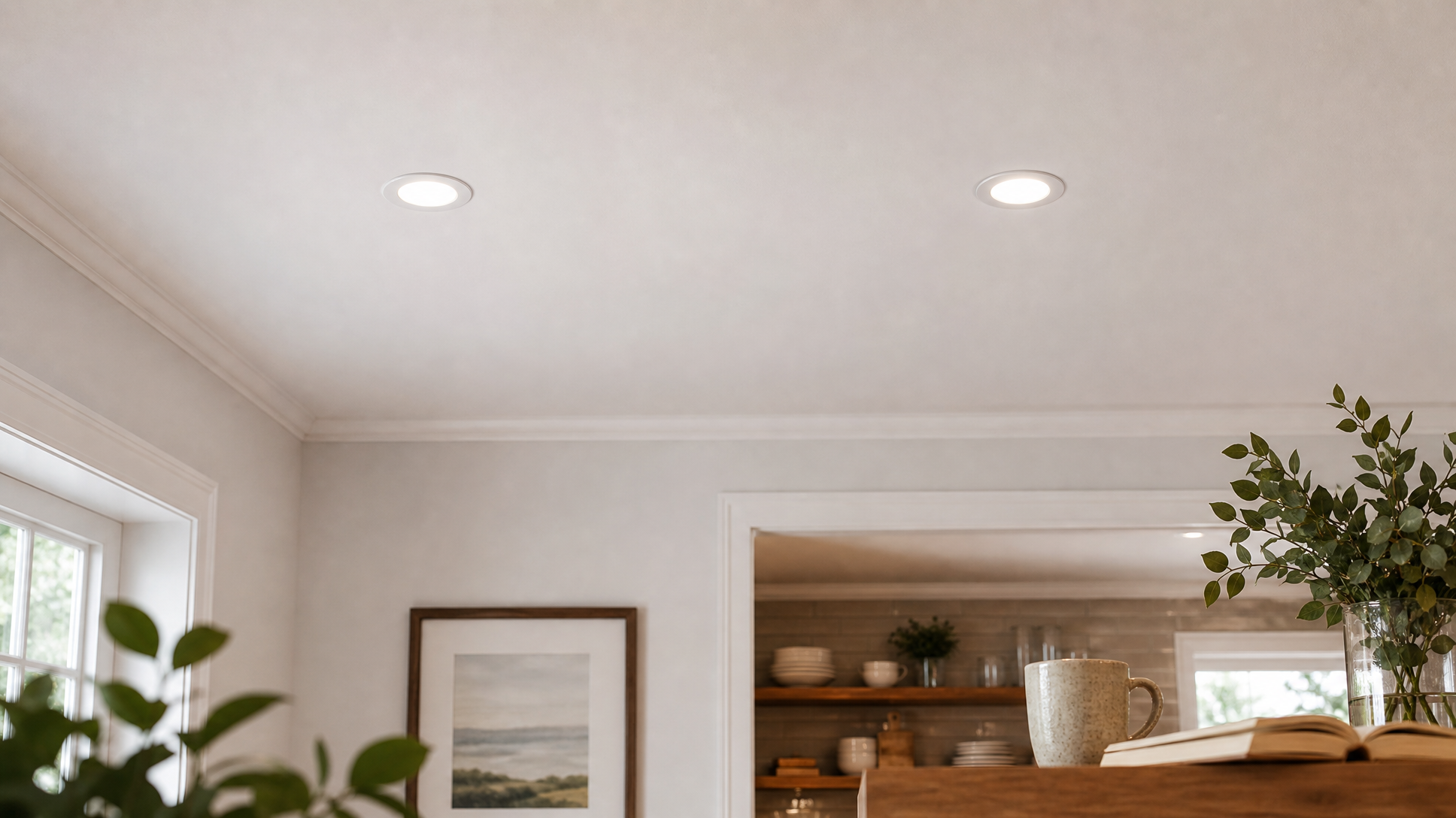
Larger cans — the older six-inch standard — can look heavy and institutional on an eight-foot ceiling, especially in a smaller room. Smaller four-inch cans tend to feel cleaner and less intrusive. The beam angle matters too: a narrow spot throws a tight cone of light that creates contrast and drama, while a wide flood distributes light more evenly. For general ambient lighting in a low-ceiling room, wider angles are usually more flattering because they reduce the cave-like effect of dark corners.
Spacing is the other variable people underestimate. Recessed lights placed too close together create a ceiling that looks busy and industrial. A rough starting point: space them apart roughly the same distance as their height from the floor. In an eight-foot room, that suggests spacing cans about four feet apart, though your specific room layout will adjust that.
The Mistakes That Make a Room Feel Shorter
Even with the right fixture type, a few common errors will compress the room visually. Here's what to avoid:
- A single overhead source with no layering. One ceiling light in the center of the room creates a spotlight effect — bright in the middle, dim at the edges, and it draws attention to the ceiling plane. Adding floor lamps, table lamps, or wall sconces pulls the eye down and outward, making the room feel larger.
- Downlights only. Lighting that only points down emphasizes the floor and makes the ceiling feel lower. An uplight — even a single floor lamp with an upward-facing shade — bounces light off the ceiling and creates the illusion of height.
- Oversized fixtures. A chandelier or pendant that's too wide for the room will crowd the space and make the ceiling feel oppressive. For a rough size guide, add your room's length and width in feet — that number in inches is a reasonable maximum diameter for a central fixture.
- Warm-only, dim-only lighting. Very warm, dim ambient light is cozy in the right room but can make a low-ceiling space feel murky. A mix of color temperatures — or a dimmable fixture you can dial up when you need the room to feel bright and airy — gives you flexibility.
- Ignoring the walls. In a low-ceiling room, the walls are your allies. Wall sconces, picture lights, and vertical lamps draw the eye along the wall rather than toward the ceiling, which perceptually stretches the room upward.
A Room-by-Room Quick Take
Bedroom: A flush mount or low-profile semi-flush for general light, plus bedside table lamps. Avoid pendants over the bed unless the room is large enough to justify them and the drop is minimal.
Living room: Layer it. A semi-flush or recessed cans for ambient light, floor lamps in corners to push light into dark spots, and a table lamp or two for warmth. One central fixture alone will always feel insufficient.
Kitchen: Recessed cans for general light, under-cabinet lighting for task work, and a pendant over the island if you have one. The pendant over the island works here because it's a defined zone — it won't feel intrusive the way a hanging fixture in the middle of a walkway would.
Hallway: Flush mounts spaced along the length of the hall, or a series of small recessed cans. Hallways are where low ceilings feel most claustrophobic — keep fixtures tight to the ceiling and let the walls carry some of the visual work with a light paint color.
If you're working through a ceiling fan choice for a low-ceiling room, look for hugger or low-profile fans specifically — they're designed to mount flush or nearly flush to the ceiling and are a much safer choice than a standard fan with a downrod. Browse ceiling fans at LightsDaddy and filter for low-profile options if that's your situation.
For fixture ideas across flush mounts, semi-flush options, and chandeliers sized for standard ceilings, the chandeliers collection is worth a look — just pay attention to the total hanging length in the product specs before you commit.
Eight-foot ceilings don't need to be a limitation. They just need fixtures chosen with the actual math in mind — and a layered approach that keeps the room from depending on a single overhead source to do everything at once.
Ready to find fixtures that actually fit your ceiling? Shop flush mounts, semi-flush lights, ceiling fans, and more — all sized for standard ceilings — at LightsDaddy.
Frequently Asked Questions
Can I use a chandelier on an 8-foot ceiling?
Yes, but you need to be selective. Look for flush-style or semi-flush chandeliers — sometimes called hugger chandeliers — that hang only a few inches below the ceiling. Avoid designs with long chains or dramatic downward tiers, which are built for rooms with ten-foot ceilings or more. Always check the total hanging length in the product specs and make sure the bottom of the fixture clears at least seven feet from the floor in any walkable area.
What size recessed lights are best for a low ceiling?
Smaller four-inch recessed cans generally look cleaner and less institutional on an eight-foot ceiling than the older six-inch standard. For general ambient lighting, choose a wide flood beam angle rather than a narrow spot — it distributes light more evenly and reduces the cave-like effect of dark corners. Space cans thoughtfully to avoid a busy, cluttered ceiling look.
How do I make a room with an 8-foot ceiling feel taller?
Layering your light sources is the most effective trick. Add at least one uplight — a floor lamp with an upward-facing shade works well — to bounce light off the ceiling and create the illusion of height. Wall sconces and vertical lamps draw the eye along the wall rather than toward the ceiling, which also helps. Avoid relying on a single overhead downlight, which tends to emphasize the ceiling plane and make the room feel compressed.
Can I hang a pendant light from an 8-foot ceiling?
Pendants work well over defined zones like a dining table or kitchen island, where people aren't walking directly underneath. The general guideline is to hang the bottom of the shade about 30 to 36 inches above the tabletop. Avoid pendants in open walkways or at the center of a room where clearance is a concern — in those spots, a flush or semi-flush mount is the safer and often better-looking choice.