Cart
0
Most people hanging a chandelier in a double-height entryway make the same mistake: they pick a fixture that looks impressive in the product photo, hang it at a comfortable height, and then wonder why the whole space still feels empty above it. The problem isn't the fixture — it's that tall spaces have different rules, and a chandelier that would dominate a standard dining room simply disappears in a two-story stairwell.
High ceilings reward length, vertical movement, and layered light. What matters most isn't total wattage or even diameter — it's how the fixture travels through the vertical space, whether it draws the eye upward, and whether it holds visual weight at the ceiling and at eye level simultaneously. Get that right, and a tall entryway becomes your home's best feature. Get it wrong, and you've got an expensive fixture floating awkwardly in mid-air.
The four chandeliers below represent four distinct approaches to solving this problem. None of them are the right answer for every room — but each one is the right answer for a specific kind of tall space.
1. The Long Linear: Fill a Kitchen Island or Dining Room with Horizontal Drama
Open-plan homes with vaulted ceilings often have a kitchen island or dining table sitting beneath a ceiling that's twelve or fourteen feet up. A single pendant or a compact chandelier just reads as a dot. A long linear fixture solves this by stretching across the horizontal plane while the rod drop handles the vertical distance.
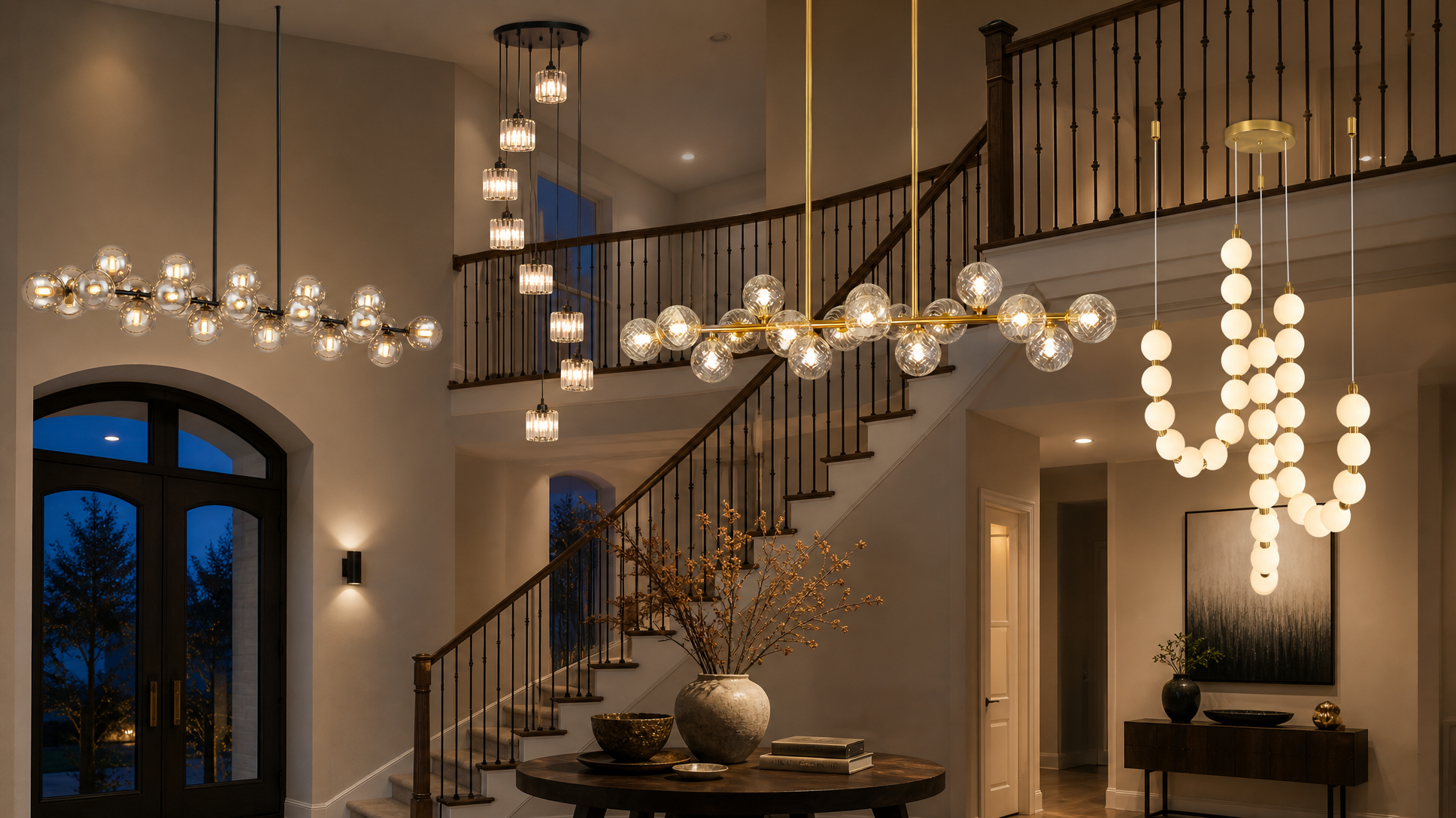
The Lzawvm Linear Chandelier Black Sputnik Chandelier is a strong example of this approach. It spans 70 inches end to end and carries 22 lights clustered in a sputnik-style arrangement along a matte black linear bar, with smoked gray glass globe shades that let warm light filter through while adding a layer of visual texture. The smoke-tinted glass keeps it from feeling stark, and the black finish grounds it in a way that brushed nickel or chrome wouldn't in a contemporary space. Over a long dining table or a large kitchen island, it reads as a single architectural statement rather than a collection of bulbs.
The key with any long linear in a tall space: let the drop rods do the work. Hang it low enough that the fixture is clearly in conversation with the surface below it, not just floating somewhere in the middle of the room.
2. The Cascading Pendant Cluster: Built for Stairwells with Real Vertical Height
An open stairwell is one of the hardest spaces to light well, because you're essentially decorating a vertical column of air. The fixture needs to look intentional from the ground floor, from the landing, and from the top of the stairs — three very different viewing angles. A single pendant or a flush-mount reads as an afterthought. What works is a cascading cluster: multiple pendants dropped at different lengths from a single ceiling canopy, so the fixture fills the vertical space rather than occupying one point in it.
The Cainjiazh High Ceilings Long Chandeliers Modern Crystal Long Pendant Light is designed specifically for this situation. It uses a multi-drop raindrop configuration — crystal-style cylindrical shades suspended at staggered heights from a single dark canopy — so the fixture creates a cascading waterfall effect as it descends through the stairwell. From the ground floor, you see the full column of light. From the landing, you're eye-level with the mid-point of the cascade. It works at every angle because it was designed to be seen from multiple floors.
If your stairwell has a rotunda or a coffered ceiling recess, this style of fixture is almost always the right call. The circular canopy fits neatly into a round recess, and the staggered drops echo the curve of a spiral staircase.
3. The Gold Bubble Linear: When You Want Warmth Without Weight
Not every tall space calls for drama. A bright, airy kitchen with white cabinets and light wood tones needs a chandelier that adds visual interest without darkening the room or competing with the natural warmth of the materials. This is where a clear-glass linear in a warm metal finish earns its place.
The Modern Chandeliers for Dining Room Swirled Glass 55 Gold Sputnik Chandelier Linear Chandelier does this well. It's a 55-inch linear bar in gold with 16 lights, each fitted with a clear swirled glass globe that refracts light in a way that plain clear glass doesn't. The swirl pattern on each globe adds texture and catches the light differently depending on the angle, so the fixture feels animated rather than static. The gold finish ties into warm wood tones and natural stone without the heaviness of a dark metal frame.
In a vaulted kitchen or a dining room with high ceilings and light-colored walls, this fixture fills the space visually without making it feel smaller. It's the difference between a chandelier that illuminates a room and one that becomes part of the room's character.
4. The Acrylic Ball Cascade: A Sculptural Option for Living Rooms and Entryways
Sometimes the right fixture for a tall space isn't a traditional chandelier at all — it's something closer to a hanging sculpture that also happens to produce light. In a double-height living room or a grand entryway, a fixture that traces a flowing, organic shape through the vertical space can be more impactful than any conventional chandelier.
The cenozo Modern Chandeliers LED Dimmable Light Acrylic Balls Ceiling Pendant Lighting takes this approach. It uses strings of frosted acrylic spheres suspended from a gold ceiling canopy in a sweeping, wave-like arrangement — multiple strands at different lengths that together create a flowing sculptural form. The frosted acrylic diffuses the LED light softly, producing an even, warm glow without harsh hotspots. It's dimmable and rated at 70 watts, and the antique gold canopy and connectors give it a warmth that keeps the overall effect from feeling cold or clinical.
This is the fixture for a stairwell or entryway where you want the lighting to function as art. The cascading ball strings follow the diagonal line of a staircase naturally, and the adjustable hanging lengths mean you can tune the silhouette to your specific ceiling height and room shape.
5. The Rule That Ties All Four Together
Every one of these fixtures works in a tall space for the same underlying reason: they treat the vertical drop as part of the design, not just a mounting necessity. The Lzawvm and the Kwpcvz linear chandeliers use long drop rods to position the fixture correctly relative to the surface below. The Cainjiazh cascade fills the vertical column of a stairwell intentionally. The cenozo sculpture uses its hanging strands to trace the shape of the space itself.
The mistake to avoid is choosing a fixture based on its diameter alone and then hanging it too high because the ceiling is tall. A chandelier hung at the wrong height in a double-height space is worse than no chandelier — it makes the room feel like the fixture was an afterthought. Prioritize drop length and vertical visual weight first. Diameter and light output are secondary decisions.
A practical starting point: in a two-story entryway or stairwell, the bottom of the fixture should typically clear the floor by at least seven feet, but the fixture itself should occupy enough of the vertical space above that point to feel intentional. In a dining room or over a kitchen island with a high ceiling, drop the fixture lower than you think you need to — it almost always looks better closer to the surface it's illuminating.
Browse the full chandelier collection at LightsDaddy — several fixtures, including the ones above, are currently marked down.
Frequently Asked Questions
How long should a chandelier drop in a two-story entryway or stairwell?
There's no single rule, but the general principle is that the bottom of the fixture should clear the floor by at least seven feet, and the fixture itself should occupy enough of the vertical space above it to feel deliberate rather than floating. In a stairwell, a cascading or multi-drop style that spans several feet vertically tends to work better than a compact fixture hung at one fixed point — it fills the column of air rather than punctuating it.
Can a linear chandelier work in a tall dining room, or does it get lost?
A linear chandelier can work very well in a tall dining room, provided the drop rods are long enough to position it correctly above the table — typically around 30 to 36 inches above the tabletop is a common guideline for dining spaces. The horizontal length of the fixture compensates for the vertical height; a long bar spanning a large table reads as intentional even in a high-ceilinged room. The mistake is hanging it too high and letting it disappear into the ceiling.
What finish works best in a bright, light-colored kitchen with high ceilings?
Warm metal finishes — gold, brass, or antique gold — tend to complement light wood tones, white cabinetry, and natural stone without darkening the space. Clear or lightly textured glass globes in those finishes keep the fixture airy. Matte black works well in more contrast-forward kitchens with darker countertops or industrial elements, where you want the fixture to anchor the space rather than blend into it.
Is a dimmable chandelier worth it for a living room or entryway?
Almost always yes, especially in spaces where the chandelier is the primary light source. A dimmable fixture lets you set a lower, warmer level for evenings and a brighter level when you need functional light — which matters in an entryway or living room that serves different purposes throughout the day. Just make sure your dimmer switch is compatible with the fixture's bulb type before purchasing.